
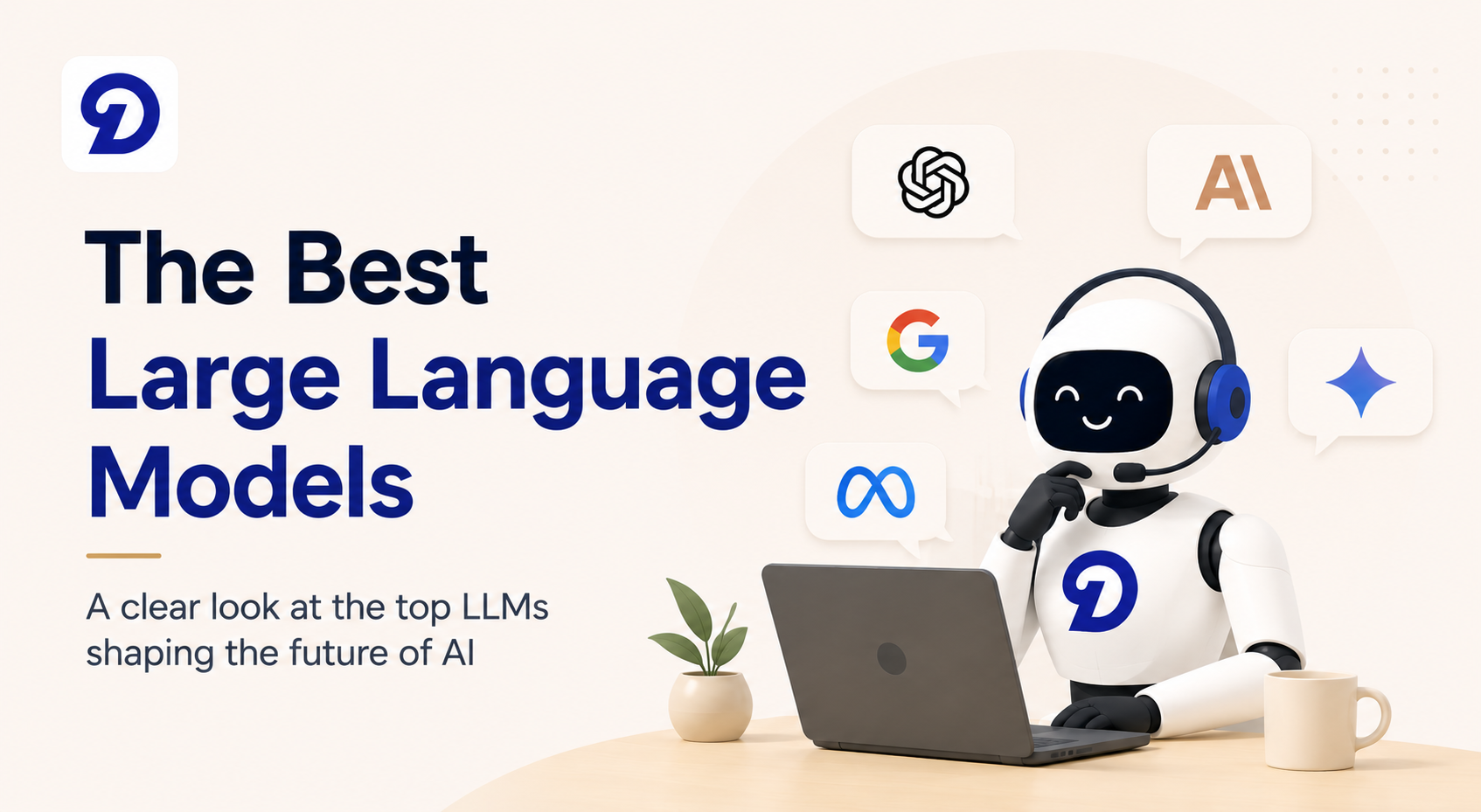
The AI industry in 2026 looks dramatically different from just two years ago. What started as a race to build conversational chatbots has evolved into a global competition centered around reasoning, multimodal intelligence, autonomous agents, coding performance, enterprise deployment, and long-context understanding.
Large Language Models commonly called LLMs, are no longer experimental technologies sitting inside research labs. They are now becoming the operating systems of modern software, powering everything from AI copilots and enterprise automation tools to healthcare diagnostics, customer support systems, software engineering workflows, and autonomous research agents.
But the biggest shift in 2026 is not simply that models are becoming smarter. It’s that the ecosystem is fragmenting into specialized strengths. Some models dominate coding. Others excel at reasoning, long-context retrieval, multilingual tasks, or low-cost deployment. Open-source models are also rapidly closing the gap with proprietary systems, creating one of the most competitive AI landscapes the industry has ever seen.
This guide explores the best LLMs in 2026 based on recent benchmarks, enterprise adoption, multimodal capabilities, developer sentiment, pricing efficiency, and overall market influence.
1. OpenAI GPT-5 & the O-Series Models
OpenAI remains the dominant force in the LLM industry in 2026. While ChatGPT originally made OpenAI famous, the company’s newer GPT-5 and reasoning-focused o-series models have pushed the frontier much further.
The biggest advantage of GPT-5 is not just intelligence, it’s versatility. The model combines reasoning, multimodal understanding, coding, voice interaction, and agentic capabilities into a single ecosystem. According to recent industry comparisons, GPT-5 currently leads in multimodal workflows and conversational responsiveness, especially for production-grade AI applications.
OpenAI’s reasoning-focused models, particularly the o-series, introduced a new approach called inference scaling, where the model spends more computational effort “thinking” through complex tasks before generating responses. This dramatically improved mathematical reasoning, software debugging, and multi-step analytical tasks.
The company’s ecosystem advantage is also difficult to ignore. OpenAI now powers thousands of SaaS products, developer platforms, AI copilots, and enterprise systems globally. The integration between ChatGPT, APIs, tools, voice systems, and multimodal workflows has made OpenAI less of a single model provider and more of a full AI infrastructure company.
However, GPT-5’s premium pricing still pushes some startups and enterprises toward open-source or lower-cost alternatives.
2. Anthropic Claude Opus 4.6
Anthropic has quietly become one of the most respected AI companies among developers, researchers, and enterprises.
While OpenAI dominates mainstream awareness, Claude models are increasingly viewed as the strongest reasoning-focused LLMs available today. Multiple recent comparisons place Claude Opus 4.6 among the top-performing models for deep analysis, coding workflows, technical documentation, and long-context reasoning.
One of Claude’s defining strengths is context handling. Anthropic has aggressively expanded context windows, with some Claude deployments supporting up to one million tokens in beta environments. This allows businesses to process enormous documents, repositories, contracts, and datasets within a single conversation.
Developers particularly praise Claude for maintaining coherence across long sessions. Unlike many models that degrade during extended interactions, Claude remains relatively stable when processing large codebases or lengthy analytical tasks.
Anthropic has also positioned itself heavily around AI safety and constitutional alignment. That emphasis on reliability has made Claude increasingly attractive to enterprises deploying AI in sensitive operational environments.
3. Google Gemini 3.1 Pro
Google entered the AI race later than OpenAI in terms of public momentum, but by 2026, Gemini has evolved into one of the most technically sophisticated multimodal AI systems available.
Gemini’s biggest strength is long-context intelligence. Google DeepMind has pushed context windows to extraordinary levels, with some Gemini models supporting up to two million tokens. This changes what businesses can realistically do with AI. Entire books, legal repositories, financial archives, or software projects can now be analyzed within a single context session.
Google also benefits from ecosystem integration. Gemini is deeply embedded into:
- Google Workspace
- Android
- Google Cloud
- Search infrastructure
- YouTube systems
- Developer tooling
This creates enormous distribution advantages.
Gemini performs especially well in research workflows, document understanding, video analysis, and retrieval-augmented generation systems. Recent academic benchmarks also showed Gemini 3 Pro achieving extremely high performance across specialized scientific domains.
FURTHER READING
➤ xAI vs. OpenAI: Why xAI’s Trade Secret Lawsuit Against OpenAI Was Dismissed
4. Meta Llama 4
Meta continues to dominate the open-weight AI ecosystem with Llama 4.
The importance of Llama cannot be overstated. While proprietary models dominate consumer-facing AI, Meta’s open-weight strategy accelerated the entire open-source AI movement globally. Thousands of startups, researchers, and enterprises now build directly on Llama architectures. Llama 4 introduced major improvements in reasoning, efficiency, multilingual understanding, and long-context handling. Recent comparisons show Llama 4 remaining one of the strongest open-weight models available in 2026.
Its biggest advantage is deployment flexibility. Companies can self-host Llama models privately, fine-tune them internally, and avoid sending sensitive enterprise data to external providers.
This has made Llama particularly attractive for:
- Regulated industries
- Government deployments
- Enterprise AI stacks
- On-premise inference systems
Meta’s aggressive open AI strategy has also intensified competition across the industry, pressuring proprietary vendors on pricing and accessibility.
5. DeepSeek V4
One of the biggest surprises in the AI industry has been the rapid rise of DeepSeek.
Originally viewed as a cost-efficient Chinese challenger, DeepSeek has evolved into a serious frontier AI competitor. Its latest DeepSeek V4 model reportedly contains 1.6 trillion parameters and significantly improved reasoning and coding capabilities.
What makes DeepSeek especially disruptive is pricing efficiency. The company offers frontier-level performance at dramatically lower inference costs compared to OpenAI or Anthropic.
DeepSeek models are gaining traction among developers because they provide:
- Strong STEM reasoning
- Competitive coding performance
- Open-source accessibility
- Extremely low API costs
Recent reports also suggest DeepSeek is aggressively optimizing models for domestic Chinese AI hardware rather than relying entirely on NVIDIA infrastructure. That geopolitical shift could significantly reshape the global AI infrastructure landscape over the next few years.
6. Mistral Large 3
Mistral AI has become Europe’s most important AI startup and one of the strongest challengers in open-weight AI development.
Mistral models are widely respected for their efficiency, multilingual performance, and strong coding capabilities. The company’s Mistral Large series competes closely with larger proprietary models while maintaining a strong commitment to open AI ecosystems.
One major differentiator is multilingual intelligence. Mistral performs exceptionally well across European and regional languages, making it highly attractive for international deployments. The company has also expanded into multimodal systems through Pixtral models capable of understanding documents, images, and charts.
Mistral’s rapid growth demonstrates that the future of frontier AI is no longer limited to Silicon Valley alone.
7. Alibaba Qwen 3.5
Alibaba Cloud has quietly built one of the strongest open AI ecosystems in Asia through the Qwen model family.
Qwen models now span a massive range of sizes and specialties, including coding, multilingual reasoning, mathematics, and multimodal understanding. Some versions reportedly support context windows approaching one million tokens. Their biggest strength is versatility combined with open accessibility. The models are increasingly popular among developers looking for customizable open-source alternatives without sacrificing strong performance.
The rise of Qwen also reflects the broader globalization of AI development. Frontier LLM innovation is no longer concentrated in the United States alone.
The Bigger Shift Happening in 2026
The most important story in 2026 is not simply which model ranks highest on benchmarks.
It’s that the industry is entering specialization.
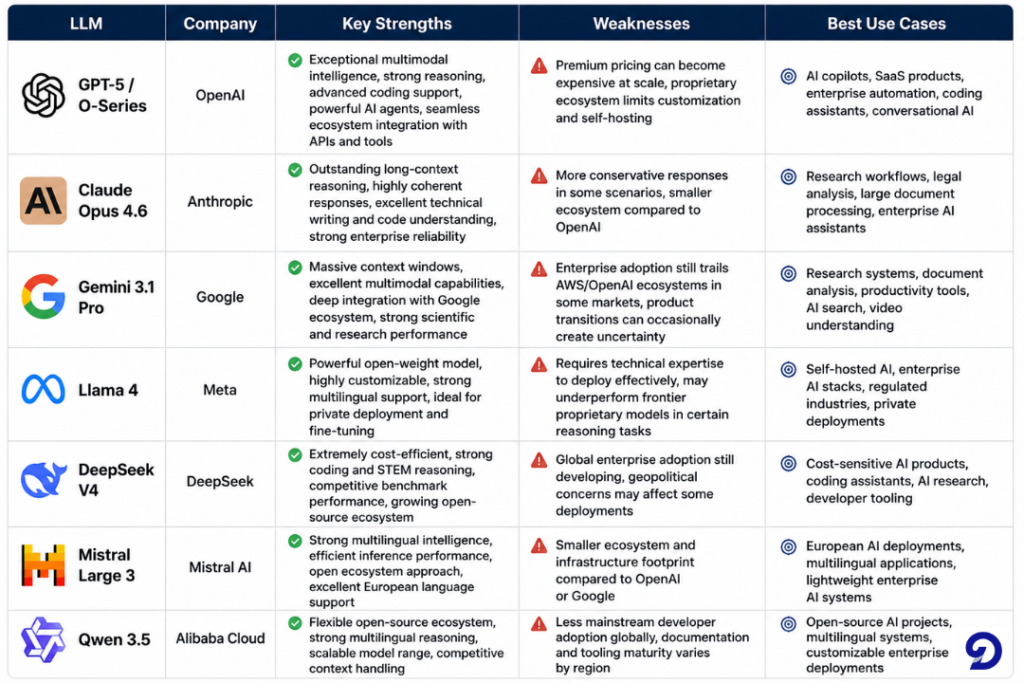
Different LLMs are increasingly optimized for different goals:
- Claude for reasoning and long-context analysis
- GPT-5 for multimodal ecosystems and agents
- Gemini for massive context and research workflows
- Llama for private deployment
- DeepSeek for cost-efficient reasoning
- Mistral for multilingual open AI
- Qwen for flexible open-source ecosystems
Businesses are no longer choosing “the smartest model.” They are choosing the model best aligned with their operational needs, infrastructure strategy, and deployment economics.
And as open-source systems continue closing the gap with proprietary models, the competitive landscape may become even more fragmented and more innovative over the next few years.
Speak With Us for Free
If this article is making you think about building an AI agent and learning more about LLMs, Doshby can help you turn that thinking into a functional AI agent.