
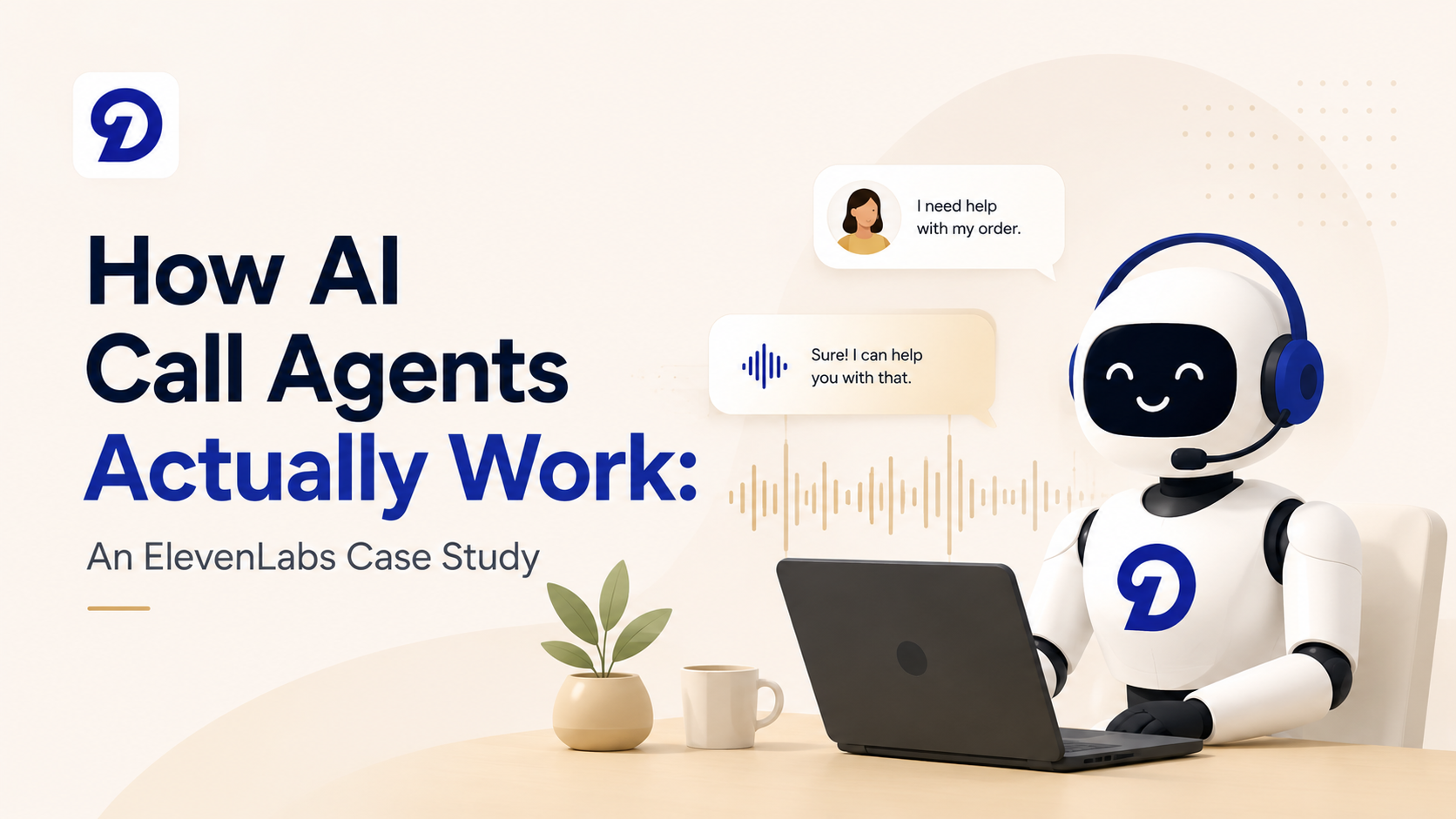
AI call agents have rapidly evolved from robotic phone trees into intelligent conversational systems capable of handling customer support, sales qualification, appointment scheduling, lead generation, and even complex operational workflows. But for many businesses, the technology still feels mysterious. People hear a realistic AI voice answering a phone call and assume there’s some kind of “magic” happening behind the scenes.
In reality, modern AI voice agents are powered by a carefully orchestrated pipeline of speech recognition, language reasoning, workflow automation, and ultra-low-latency speech synthesis all happening within milliseconds.
Platforms like ElevenLabs have become central to this transformation by making enterprise-grade conversational AI accessible to startups, agencies, and businesses without requiring massive in-house AI research teams.
This article breaks down how AI call agents actually work under the hood using ElevenLabs as a real-world case study, not just from a technical perspective, but from an operational and business standpoint as well.
The “magic” of a voice agent like those built on ElevenLabs isn’t a single process, but a high-speed loop of three core technologies orchestrated to minimize latency.
The Core Goal of an AI Voice Agent
At the center of every AI call system is a simple objective: create a conversation that feels fluid, responsive, and useful enough that people naturally continue engaging with it.
That sounds straightforward, but human conversation is one of the most difficult behaviors to replicate computationally. People interrupt each other, change topics halfway through sentences, speak with different accents, pause unexpectedly, and communicate emotion through tone rather than words alone. Traditional automated phone systems struggled because they were built around rigid logic trees rather than contextual understanding.
Modern AI agents work differently. Instead of relying on predefined “if-this-then-that” paths, they interpret intent dynamically. This allows conversations to feel flexible rather than scripted.
For businesses, the implications are massive. AI voice agents are no longer limited to answering simple FAQs. Companies are now deploying them to handle inbound support, sales calls, appointment scheduling, debt collection, onboarding flows, and operational tasks that once required entire call teams. According to McKinsey & Company, conversational AI technologies are significantly reducing customer service costs while improving response times and availability.
But to understand why these systems feel more human today, you need to understand the architecture underneath them.
Everything Starts With Listening
The first challenge an AI call agent faces is deceptively simple: accurately hearing what someone says in real time.
This process is handled through Speech-to-Text technology, often abbreviated as STT. In ElevenLabs’ ecosystem, this layer is powered by Scribe, a speech recognition model designed specifically for live conversational environments.
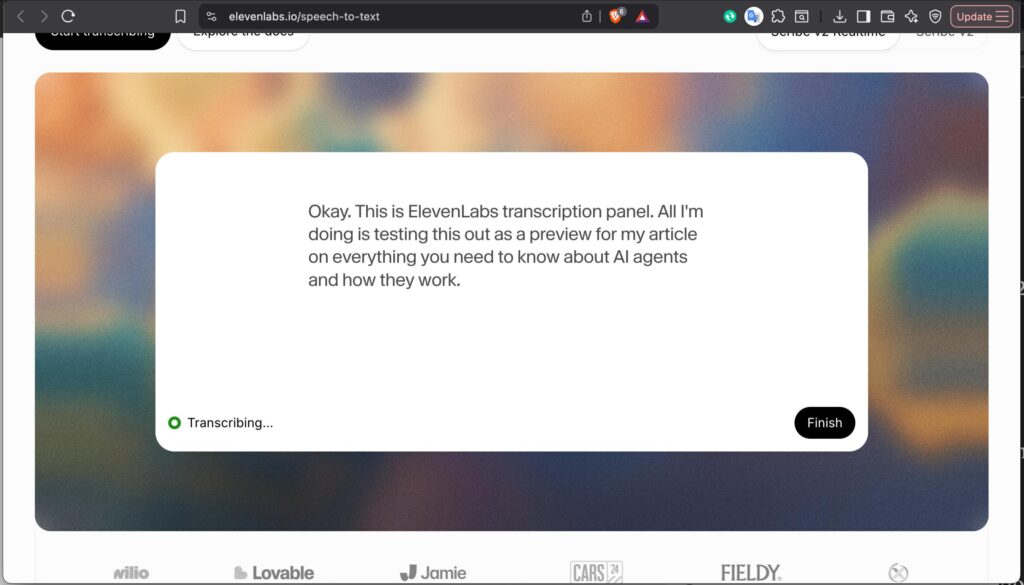
What makes conversational transcription difficult is speed. Humans do not wait patiently after every sentence during normal conversation. We naturally expect immediate reactions while we are still speaking. Older transcription systems typically waited for an entire sentence before processing audio, which created unnatural delays and awkward silences. Modern streaming transcription systems solve this by processing speech continuously as audio arrives.
That difference changes the entire experience.
Imagine a customer calling a dental clinic and saying:
“Hi, I was supposed to come in tomorrow afternoon, but something came up and I need to move the appointment to next week.”
A modern AI agent begins interpreting meaning before the speaker even finishes the sentence. That ability dramatically reduces latency and allows conversations to flow more naturally.
Speech recognition also has to operate in messy real-world conditions. Callers may speak quickly, mumble words, switch accents, use slang, or call from noisy environments. Phone calls themselves compress audio quality heavily, making interpretation even harder. Modern STT systems are trained specifically to handle these imperfections because accuracy at this stage determines the quality of everything that follows.
The LLM Becomes the Conversational Brain
Once speech is converted into text, the next layer takes over: the Large Language Model.
This is the reasoning engine behind the conversation. In ElevenLabs’ conversational AI platform, developers can integrate models like GPT-4o or Claude to interpret requests and generate responses.
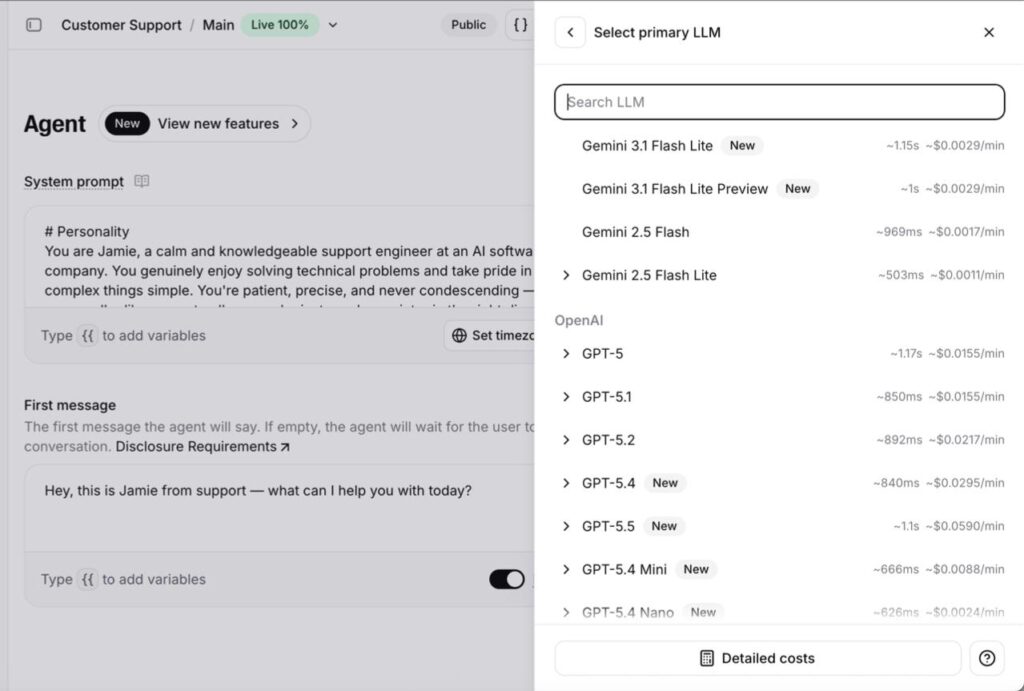
This stage is where modern AI agents diverge sharply from older automated phone systems. Traditional systems depended heavily on decision trees and keyword matching. If a caller used unexpected wording, the system often failed entirely.
Large language models work differently because they understand context rather than just keywords.
For example, these requests all communicate the same intention:
“I need to change my booking.”
“Can we move my appointment?”
“Thursday won’t work for me anymore.”
A modern LLM understands that all three statements likely involve rescheduling, even though the wording differs completely. That contextual reasoning is what makes conversations feel flexible and intelligent.
But the language model itself is only part of the equation. What truly shapes the behavior of an AI call agent is the system prompt operating behind the scenes.
FURTHER READING
➤ How Netflix Saves $1 Billion a Year with AI
The System Prompt Quietly Controls Everything
Most users never see the prompt, yet it is arguably the most important component of the entire agent.
The system prompt acts like operational instructions for the AI. It defines how the agent should behave, how formal or casual it should sound, what rules it must follow, how it should handle objections, and when it should escalate to a human operator.
A healthcare receptionist AI might be instructed to remain calm, professional, empathetic, and privacy-conscious. A sales-focused AI agent may be designed to sound persuasive, energetic, and proactive during lead qualification calls.
Without careful prompt engineering, even highly advanced language models behave inconsistently. This is one reason many businesses underestimate the complexity of deploying conversational AI successfully. The quality of the AI often depends less on the raw model and more on how well the surrounding instructions are designed.
Why Knowledge Bases Matter So Much
One of the biggest weaknesses of general-purpose AI systems is hallucination — confidently generating inaccurate information time an time again, that it becomes dangerous in customer-facing business environments.
To solve this, ElevenLabs allows developers to connect external knowledge bases containing verified company information. These knowledge systems can include PDFs, internal documentation, website URLs, pricing sheets, policies, or operational manuals.
Resource: Knowledge Base Guide
This transforms the AI from a general conversational model into a company-specific operational assistant.
A logistics company, for example, can upload delivery policies and service coverage information so the AI answers based on official business data rather than generating assumptions. A medical clinic can upload insurance guidelines and appointment procedures to ensure accuracy during patient conversations.
This grounding layer is becoming increasingly important as businesses move from AI experimentation into production-grade deployments.
Modern AI Agents Are Action Oriented, Not Just Talk
One of the most important developments in conversational AI is the rise of action-based workflows. Early AI assistants mainly responded conversationally. Modern agents increasingly function as operational interfaces connected directly to backend systems.
This is where tools and webhooks become essential. Through ElevenLabs’ tool infrastructure, AI agents can trigger actions inside external systems whenever certain intents are detected during a conversation.
Resource: Agent Tools Documentation
For example, if a customer says:
“Can you book me for Friday at 3 PM?”
The AI can communicate with scheduling software, verify availability, create the booking, send confirmation messages, and continue the conversation naturally afterward.
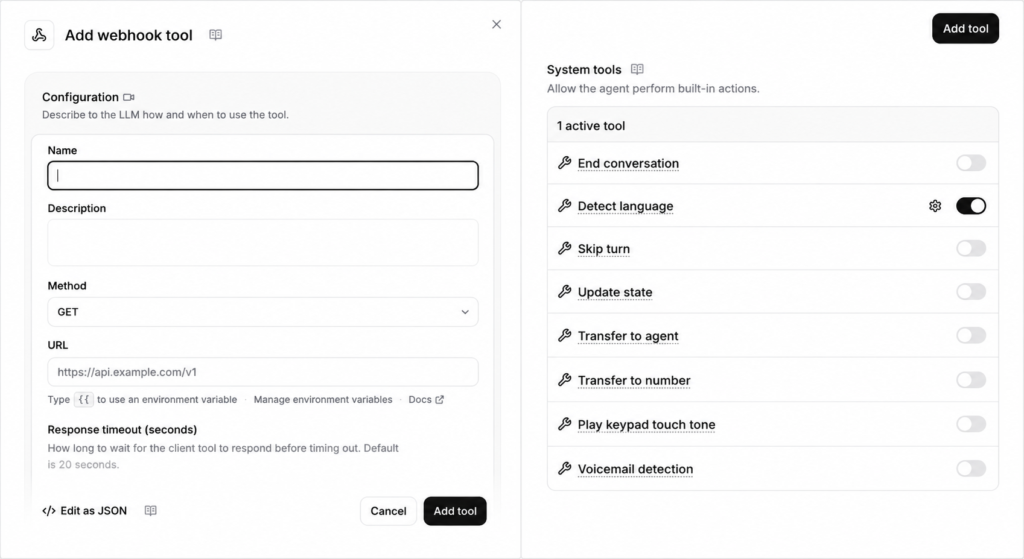
The caller experiences this as a smooth conversation. Behind the scenes, however, multiple APIs and automation systems are being orchestrated simultaneously.
This is why AI call agents are increasingly viewed not as chatbots, but as digital operational workers.
The Voice Layer Is Where Everything Either Feels Human or Fails
After the AI generates a response, the final challenge is converting text back into natural speech quickly enough to maintain conversational flow.
This is where ElevenLabs became widely recognized in the AI industry.
Its voice synthesis systems focus heavily on realism and ultra-low latency. The company’s Flash model is specifically optimized to reduce response delays during live conversations.
Latency matters far more than most people realize.
Humans are extremely sensitive to conversational pauses. Even a one-second delay can make an interaction feel awkward or artificial. Older AI phone systems often sounded robotic not only because of poor voice quality, but because their responses arrived too slowly.
Modern systems minimize this delay by streaming audio generation continuously rather than waiting for full sentences to complete.
Equally important is emotional realism. Human communication relies heavily on pacing, emphasis, pauses, breathing patterns, and vocal tone. ElevenLabs’ speech synthesis models attempt to replicate these nuances, which significantly improves engagement and trust during conversations.
That emotional realism is one reason AI voice agents have advanced so quickly in customer-facing industries.
The Future of AI Call Agents Is Much Bigger Than Customer Support
Many people still think AI call agents are simply automated receptionists. In reality, they are evolving into full conversational operating systems for businesses.
Modern agents can already retrieve information, execute workflows, interact with APIs, make decisions, escalate intelligently, and operate continuously at scale. As language models improve further, these systems will increasingly move into areas like healthcare coordination, financial operations, logistics management, and internal enterprise workflows.
The larger shift happening underneath all of this is that businesses are beginning to treat conversational AI as infrastructure rather than software.
And platforms like ElevenLabs are helping accelerate that transition by reducing the technical barriers required to deploy highly realistic AI communication systems at production scale.
Speak With Us for Free
If this article is making you think about building your own agent, Doshby can help you turn that thinking into a functional AI agent.