
The Open-Source Coding Agent Taking On Claude Code and Cursor
In early 2026, Anthropic enforced its terms of service against third-party tools that were using the Claude API to build Claude Code alternatives. The developer community responded sharply. DHH “David Heinemeier Hansson”, creator of Ruby on Rails and one of the most vocal figures in software development called it “very customer hostile.”
The unintended consequence was significant. Interest in OpenCode who are an independent, open-source AI coding agent that owed nothing to Anthropic’s terms, surged. According to the SST/Anomaly team’s own documentation, what followed was more organic growth than any marketing campaign could have generated. Anthropic’s enforcement had inadvertently made the case for the one tool in the category that was genuinely vendor-independent.
That’s the kind of origin story that explains a number: 160,000 GitHub stars and 7.5 million monthly active developers in under a year, making OpenCode the fastest-growing open-source developer tool in history. For context, VS Code, Microsoft’s open-source IDE, now the most widely used editor in the world has 185,000 GitHub stars accumulated since 2015. OpenCode covered nearly the same ground in twelve months, with no marketing team, no subscription product, and no IDE lock-in.
That number makes it worth understanding what OpenCode actually is.
What Is OpenCode AI?
OpenCode AI is a free, open-source, model-agnostic AI coding agent, which is MIT-licensed, terminal-native, and designed to connect to more than 75 AI model providers, including fully local models that never send your code to an external server. Unlike Claude Code (locked to Anthropic’s models), Cursor (subscription-based, model-curated), or GitHub Copilot (Microsoft’s ecosystem), OpenCode is built around a single principle: you choose the best LLM, you own the data, and you are not locked into any vendor’s pricing or terms.
The core software is free. You pay only for the AI API tokens you consume or nothing at all, if you run a local model via Ollama.
Who Built It, and Why It Matters
OpenCode was launched on June 19, 2025 by Anomaly Innovations, the Y Combinator 2021 company formerly known as SST (Serverless Stack). The founding team: Jay V (CEO) and Frank Wang (CTO), who met in their first week at the University of Waterloo and have built developer tools together ever since; Dax Raad, an early SST user who became a co-founder; and Adam Elmore. SST had grown to 25,000 GitHub stars and turned profitable by 2025, backed post-YC by investors including the founders of PayPal, LinkedIn, Yelp, and YouTube.
The team’s relevant background detail is not the funding but it’s the terminal-first DNA. During the SST years, the team built a terminal user interface for the framework itself and launched Terminal, a coffee subscription service operated entirely through an SSH connection, generating over $100,000 in sales in its first year. That obsession with terminal-native tooling was what positioned them to build OpenCode when AI coding agents emerged.
One piece of history worth knowing before you read coverage of OpenCode elsewhere: the project has a fork dispute in its past. The original OpenCode repository was created by a separate developer in 2024 as a Go-based terminal agent. Dax Raad and the SST team became major contributors, owned the opencode.ai domain, and built the community. When “Charm” the company behind the popular Bubbletea terminal UI library attempted to take ownership of the project, Raad and the team objected. Charm renamed their continuation “Crush.” The SST/Anomaly fork at github.com/sst/opencode, rewritten in TypeScript using Bun, is what the industry means by OpenCode in 2026, and is the version this post covers.
Why does the origin story matter for business buyers? Because OpenCode was not built by a Big Tech lab monetising a model, or a VC-backed startup on the way to a subscription product. It was built by a small team with a long track record of open developer tooling, for whom model-agnosticism was a founding principle rather than a feature bolted on to compete. That distinction matters when you’re evaluating whether “open source” here means genuinely open, or means “free tier with an upsell.”
FURTHER READING
➤ Agentic Engineering vs. Vibe Coding
What Actually Makes OpenCode Different
Most coverage of OpenCode lists features. This section covers the four that have genuine business consequence, and why they matter beyond the spec sheet.
1. LSP integration
Language Server Protocol integration means OpenCode connects to your project’s language server; Pyright for Python, rust-analyzer for Rust, gopls for Go, clangd for C/C++, and 18+ others, and gives the AI actual type information, function signatures, import paths, and live compiler diagnostics rather than treating your code as plain text. No other major AI coding agent does this.
The practical consequence: those diagnostics feed back to the model mid-task, enabling self-correction before the agent reports back to you. In DataCamp’s head-to-head testing, OpenCode generated 21 more tests on average than Claude Code on the same underlying model. That difference traces directly to the LSP feedback loop so the agent knows what the compiler knows, and it uses that to produce more complete, more defensive output.
For engineering teams where test coverage is a quality gate, this is not a cosmetic advantage.
2. Privacy and local deployment
OpenCode stores all session data in a local SQLite database. OpenCode itself never receives your code. The important caveat: if you’re using a cloud model provider (Anthropic, OpenAI, Google), your code still passes through that provider’s API under their terms. What OpenCode prevents is a third-party aggregator which is the coding agent platform itself from accumulating your codebase.
For true air-gap deployment, pair OpenCode with Ollama or LM Studio and the entire agentic loop runs locally. No external API calls. No data residency concerns. This is the only setup in the AI coding space in 2026 that satisfies hard regulatory requirements in healthcare, legal, defence contractors, and government developers who cannot send client code to any external server. Claude Code, Cursor, and GitHub Copilot have no equivalent option.
3. Real model agnosticism
Frank Wang designed OpenCode to swap AI providers like changing batteries, and not as an afterthought, but as the central architectural decision from day one just way MCP works. Anthropic, OpenAI, Google Gemini, AWS Bedrock, Azure, Groq, OpenRouter, any OpenAI-compatible endpoint, or fully local via Ollama. You bring your own API keys and pay provider rates directly, with no markup.
For teams that want a pre-vetted recommendation rather than choosing from 75 options, OpenCode Zen is a curated, benchmarked model tier that narrows the selection to a tested shortlist. It is the answer to the question “which model should I actually use with this?”
4. Cost economics at team scale
At $20 per seat per month for Claude Code or Cursor, a 50-developer team pays $12,000 a year before a single line of AI-generated code is written. OpenCode’s software cost is zero. API token consumption varies by usage, but teams running local models via Ollama report zero marginal cost per session. One consulting team documented using OpenCode with Ollama and DeepSeek Coder for NDA-bound client work which implies that zero code hit any cloud, zero per-query cost. For engineering organizations where AI coding is shifting from individual experiment to team-wide infrastructure, the cost structure of the tool is no longer a peripheral consideration.
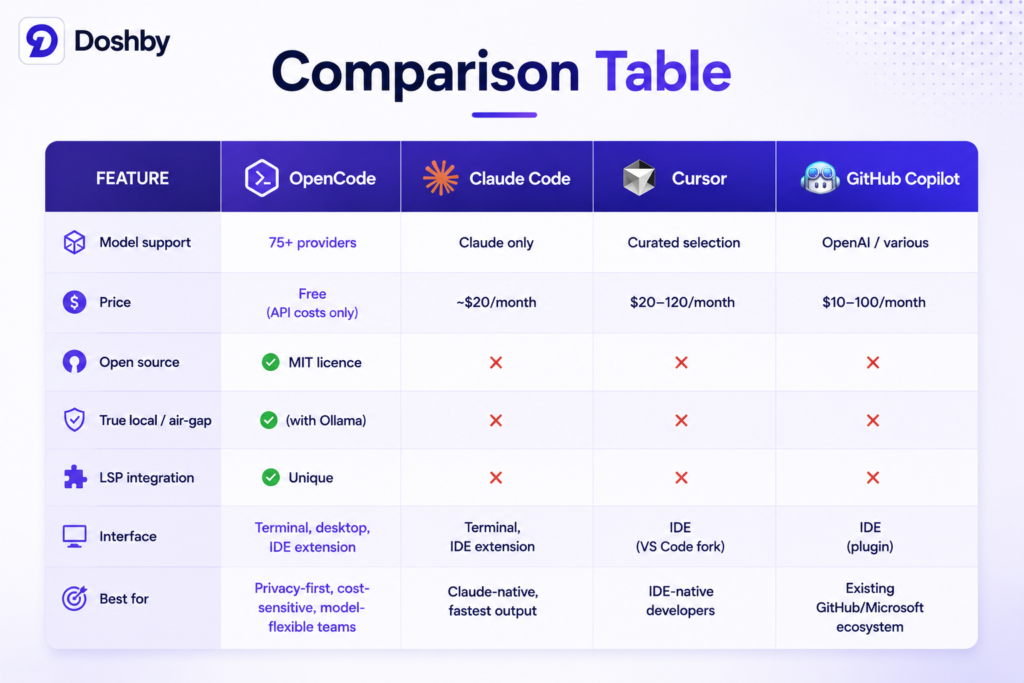
The honest caveat that belongs alongside the table above: Builder.io’s head-to-head testing found that OpenCode is approximately 78% slower than Claude Code on the same underlying model. The output is more thorough as the LSP feedback loop and longer reasoning produce more complete results but it takes longer to arrive. For engineering teams optimizing for iteration speed above all else, that trade-off matters. For teams optimizing for output quality, test coverage, or regulatory compliance, it may be exactly the right exchange.
LogRocket’s AI dev tool power rankings for July 2026 place OpenCode at number one in the open-source category with “no serious challenger to its open infrastructure thesis.” That ranking reflects adoption and architecture, not raw speed.
Who OpenCode Is Right For (And Who It Isn’t)
OpenCode is the right choice when:
Your industry has hard data residency or regulatory requirements such as healthcare, legal, defence, government, that prohibit code from leaving your infrastructure. This is the one scenario where no proprietary tool is an alternative; OpenCode with local models is the only option.
Your team has 50 or more developers and per-seat SaaS licensing costs are a meaningful budget line. The economics shift substantially at scale, particularly when combined with OpenRouter or local models.
Your developers work primarily in the terminal like Neovim, Emacs, or a terminal-first workflow. OpenCode is native to this environment in a way that Cursor (a VS Code fork) cannot replicate.
Your engineering strategy requires the ability to switch AI providers without workflow disruption. If your current provider changes pricing, changes terms, or is acquired then the situation OpenCode’s own growth was partly fueled by, the need for portability; OpenCode gives you that by design.
OpenCode is not the right choice when:
Raw speed is the primary productivity metric. Claude Code on Claude’s own models is faster, and if iteration speed determines how quickly your team ships, that 78% speed difference is a real cost.
Your developers are primarily IDE-native and have no terminal workflow. Cursor’s IDE experience remains the most polished in the category for that use case.
Your team has a single-model contract or enterprise agreement with Anthropic or Microsoft that covers API costs — in which case the cost economics of OpenCode’s model may not apply.
Final Thoughts
OpenCode AI’s growth story spanning from a GitHub repository to 7.5 million monthly active developers in under a year, without a marketing team or a subscription product is the clearest available signal that it is solving a real problem. The problem is not that AI coding agents don’t exist. It’s that the dominant ones are proprietary, model-locked, and increasingly expensive to run at team scale.
OpenCode’s answer is structurally simple: open-source the harness, let developers bring their own model, keep all session data local, and build the one feature (LSP integration) that makes the output meaningfully more thorough than anything proprietary. Whether that trade-off is more thorough but slower or free but requiring more configuration, choosing which AI coding agent is right for your team depends on what you’re optimizing for.
At Doshby, how teams structure their AI-assisted development workflow ranging from which tools, which models, which governance is a recurring part of how we help engineering organizations deploy agentic AI responsibly. If you’re evaluating the right setup for your team, get in touch or read our guide to agentic engineering for the broader framework these tools sit inside.