
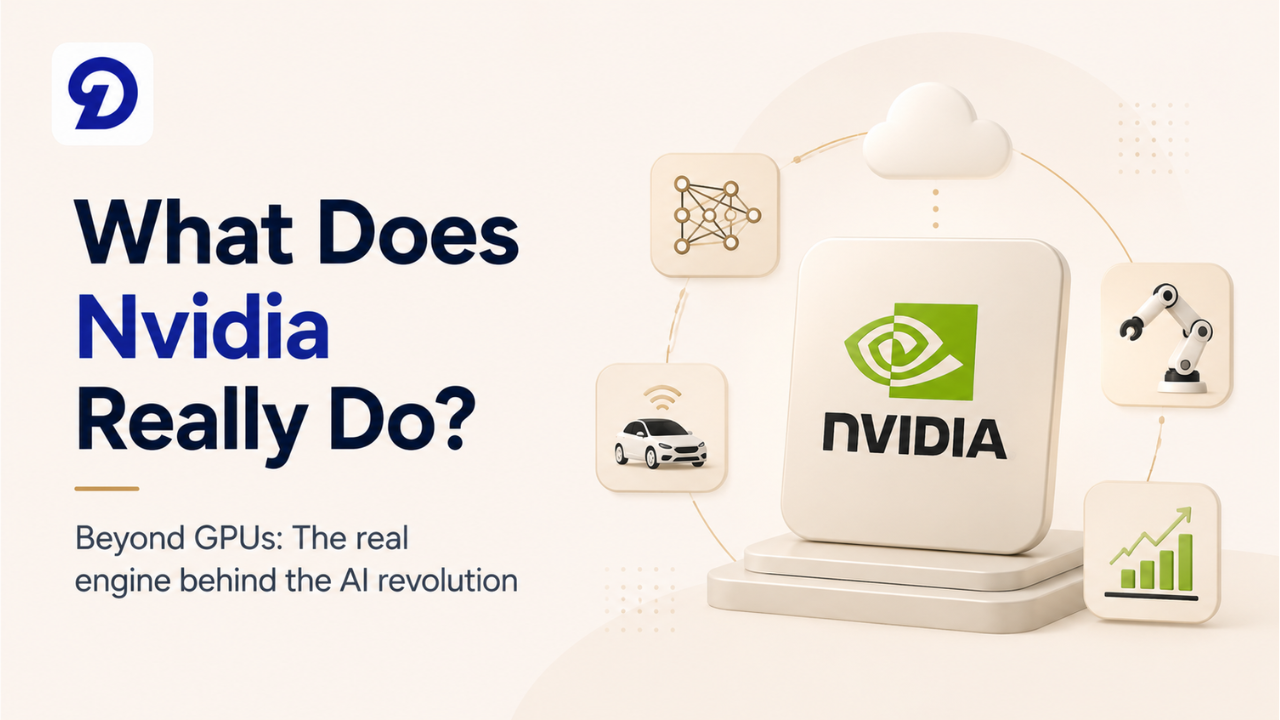
The Company Powering the AI Revolution
When most people hear the name Nvidia, they automatically think of gaming.
For years, Nvidia was known as the company behind the powerful graphics cards that brought video games to life. Gamers bought Nvidia GPUs to achieve smoother frame rates, better graphics, and more immersive gaming experiences. If you built a high-performance gaming PC anytime over the past two decades, chances are an Nvidia graphics card was at the heart of it.
But in 2026, describing Nvidia as a “graphics card company” is like describing Amazon as an online bookstore.
Today, Nvidia sits at the center of the global artificial intelligence boom. Its technologies power ChatGPT, autonomous vehicles, robotics, scientific research, cloud computing platforms, medical breakthroughs, and some of the world’s most advanced supercomputers. The company has become one of the top AI hyperscalers in the world because it provides the infrastructure that modern AI runs on.
So what does Nvidia actually do?
The answer is far bigger than most people realize.
The Origins of Nvidia: A Company Built Around Graphics
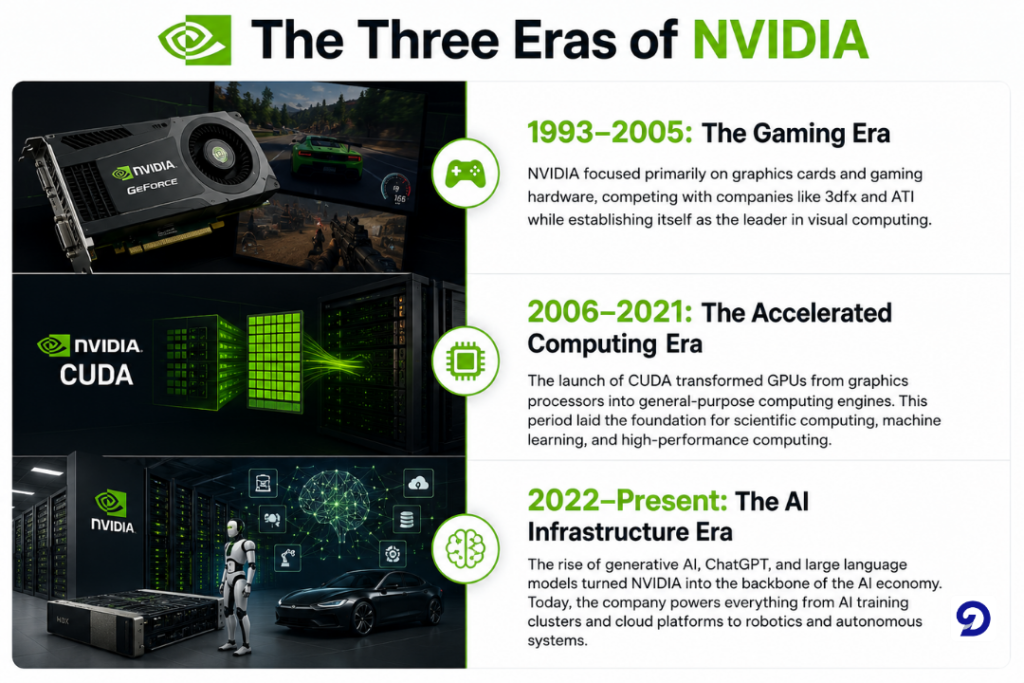
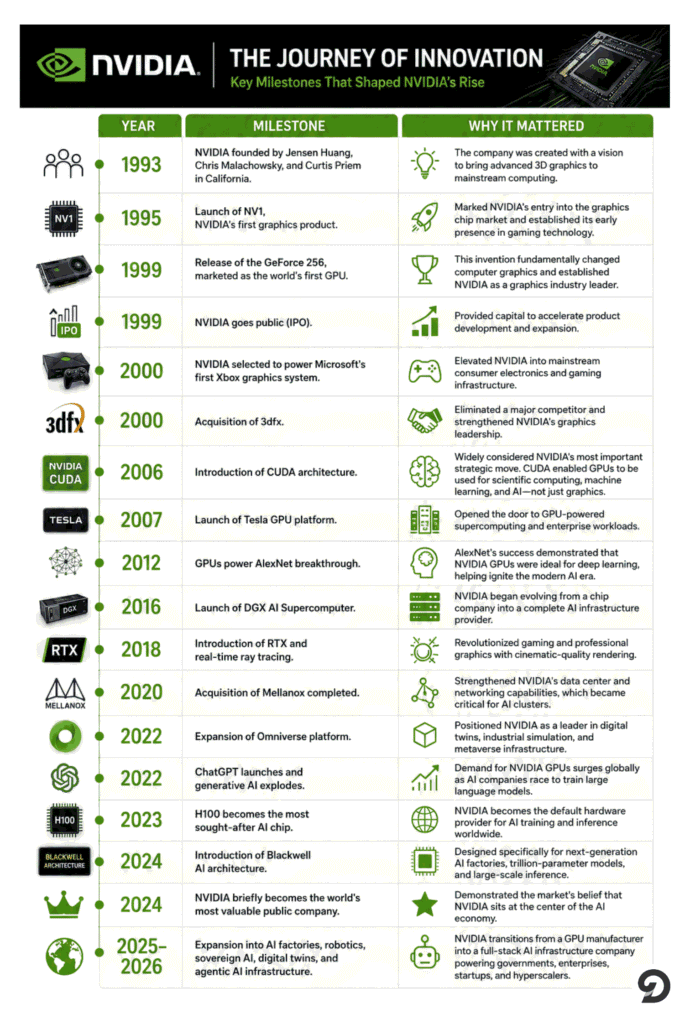
Nvidia was founded in 1993 by Jensen Huang, along with Chris Malachowsky and Curtis Priem.
At the time, personal computers were becoming increasingly powerful, but rendering complex graphics remained a major challenge. Video games, 3D design applications, and visual computing workloads demanded far more processing power than traditional CPUs could efficiently provide.
Nvidia recognized an opportunity.
Rather than relying solely on a computer’s central processor, the company focused on creating specialized hardware designed specifically for graphics calculations. This led to the development of the Graphics Processing Unit, or GPU. The launch of the GeForce 256 in 1999 is widely considered one of Nvidia’s most important milestones. The company called it the world’s first GPU, fundamentally changing how computers processed visual information.
Initially, this innovation was aimed primarily at gaming. Few people could have predicted that the same technology would eventually become the foundation of the AI revolution.
Nvidia Doesn’t Sell AI. It Sells the Infrastructure That Makes AI Possible.
One of the biggest misconceptions about Nvidia is that it builds consumer AI products like ChatGPT. It doesn’t.
Unlike companies such as OpenAI, Anthropic, or Google, Nvidia is not primarily focused on creating chatbots or AI applications. Instead, Nvidia provides the hardware and software infrastructure that allows those companies to build AI systems in the first place.
A useful analogy is the California Gold Rush.
During the gold rush, many prospectors searched for gold, but some of the most successful businesses were the companies selling picks, shovels, tools, and equipment. Nvidia occupies a similar position in the AI economy. Rather than competing directly with every AI company, it supplies the technology that nearly all of them need.
When OpenAI trains a new language model, when Tesla develops autonomous driving systems, or when researchers simulate protein structures, Nvidia’s hardware is often doing much of the heavy lifting behind the scenes. This infrastructure-centric business model has proven incredibly powerful because it allows Nvidia to benefit regardless of which AI company ultimately wins.
The GPU: Nvidia’s Most Important Product
To understand Nvidia, you must first understand why GPUs matter.
Traditional CPUs are designed to handle a wide variety of tasks sequentially. They are extremely versatile but not always the most efficient solution for massively parallel workloads.
A GPU works differently. Instead of optimizing for a few complex operations at a time, GPUs are designed to perform thousands of calculations simultaneously. This makes them ideal for rendering graphics, which requires processing millions of pixels at once.
Years later, researchers discovered something important.
The same parallel processing architecture that made GPUs excellent for graphics also made them exceptionally good at training neural networks. Artificial intelligence systems require enormous numbers of mathematical calculations. Training a large language model can involve processing trillions of parameters across massive datasets. CPUs can perform these calculations, but GPUs can do them dramatically faster.
This realization transformed Nvidia from a gaming company into one of the most important technology firms in the world.
How Nvidia Became the Backbone of Artificial Intelligence
The AI boom did not happen overnight.
For years, Nvidia invested heavily in GPU architecture, developer tools, and research ecosystems. One of the company’s most important decisions was launching CUDA in 2006. CUDA is a software platform that allows developers to use Nvidia GPUs for purposes beyond graphics rendering.
At the time, this may have seemed like a niche technical decision. In retrospect, it became one of the most important strategic moves in technology history. CUDA enabled researchers to use GPUs for scientific computing, machine learning, data analytics, and eventually artificial intelligence.
As deep learning research accelerated in the 2010s, Nvidia was perfectly positioned. Researchers discovered that Nvidia GPUs dramatically reduced AI training times. Universities adopted them. Startups adopted them. Technology giants adopted them. By the time generative AI exploded into mainstream awareness following ChatGPT’s launch, Nvidia had already spent more than a decade building the ecosystem required to support it.
Today, many of the world’s most advanced AI models are trained using Nvidia hardware.
Nvidia’s Data Center Business Is Now Bigger Than Gaming
One of the most surprising facts about Nvidia is that gaming is no longer its primary revenue driver.
The company’s data center business has become significantly larger. Data centers are facilities filled with servers and computing infrastructure that power cloud services, AI systems, enterprise applications, and digital platforms.
Companies such as Microsoft, Amazon, Google, Meta, Oracle, and OpenAI purchase massive quantities of Nvidia hardware to power their AI workloads. The demand has become so intense that Nvidia’s AI chips are often sold out months before delivery.
Products such as the H100, H200, and Blackwell GPU platforms have become some of the most sought-after pieces of technology on the planet. These chips serve as the computational engines behind many of today’s most advanced AI systems.
In many ways, Nvidia has become the arms dealer of the AI race. Every major AI company needs computing power, and Nvidia supplies much of it.
FURTHER READING
➤ Why Nvidia’s $100 Billion Investment Path with OpenAI Has Stalled
Nvidia Is Also a Software Company
Another common misunderstanding is that Nvidia only sells hardware. In reality, software plays a crucial role in the company’s success. CUDA remains one of Nvidia’s biggest competitive advantages because it creates an ecosystem that developers become deeply invested in.
Over the years, Nvidia has expanded this software ecosystem significantly. The company now provides tools for: AI model development, robotics simulation, autonomous vehicle training, digital twins, scientific computing, healthcare research, industrial automation, and advanced visualization.
This creates a powerful network effect. When developers build solutions using Nvidia’s software stack, switching to competing hardware becomes more difficult. The result is a competitive moat that extends far beyond the physical chips themselves.
Beyond AI: Nvidia’s Expanding Technology Empire
Although artificial intelligence dominates headlines, Nvidia’s ambitions extend well beyond AI training.
The company is heavily involved in autonomous vehicles through its DRIVE platform. Automotive manufacturers use Nvidia technology to develop self-driving systems, in-car AI assistants, and advanced driver-assistance features.
Nvidia is also investing heavily in robotics. Through platforms such as Isaac, developers can train robotic systems in virtual environments before deploying them into real-world settings.
Another growing area is digital twins.
Using its Omniverse platform, Nvidia enables companies to create virtual replicas of factories, warehouses, cities, and industrial systems. These simulations help organizations optimize operations, test scenarios, and improve efficiency before making costly real-world changes. Healthcare, scientific research, manufacturing, and telecommunications are also becoming increasingly important markets for the company.
Why Nvidia Became One of the World’s Most Valuable Companies
Nvidia’s rise is not simply the result of producing faster chips.
The company succeeded because it identified a technological shift long before most of the market understood its significance.
While competitors focused primarily on hardware performance, Nvidia built an entire ecosystem combining chips, software, developer tools, research partnerships, and enterprise infrastructure. As a result, when the generative AI revolution arrived, Nvidia was already positioned as the default platform for AI development.
That strategic foresight transformed the company from a gaming hardware manufacturer into one of the most influential technology businesses in the world.
The Bottom Line: Nvidia Powers the Modern AI Economy
So, what does Nvidia really do?
At its core, Nvidia builds the computational infrastructure that powers modern artificial intelligence and advanced computing.
Its GPUs train AI models. Its software enables developers. Its data center technologies power cloud platforms. Its tools help create autonomous vehicles, robotics systems, scientific discoveries, and industrial simulations.
The company may have started by helping gamers render better graphics, but today Nvidia’s technology is helping shape the future of computing itself.
And as AI continues to expand into every industry, Nvidia’s role may become even more important. While most companies are building AI applications, Nvidia is building the foundation that makes those applications possible.
.
Speak With Us for Free
If this article is making you think about building your own groundbreaking product, Doshby can help you turn that thinking into reality.