
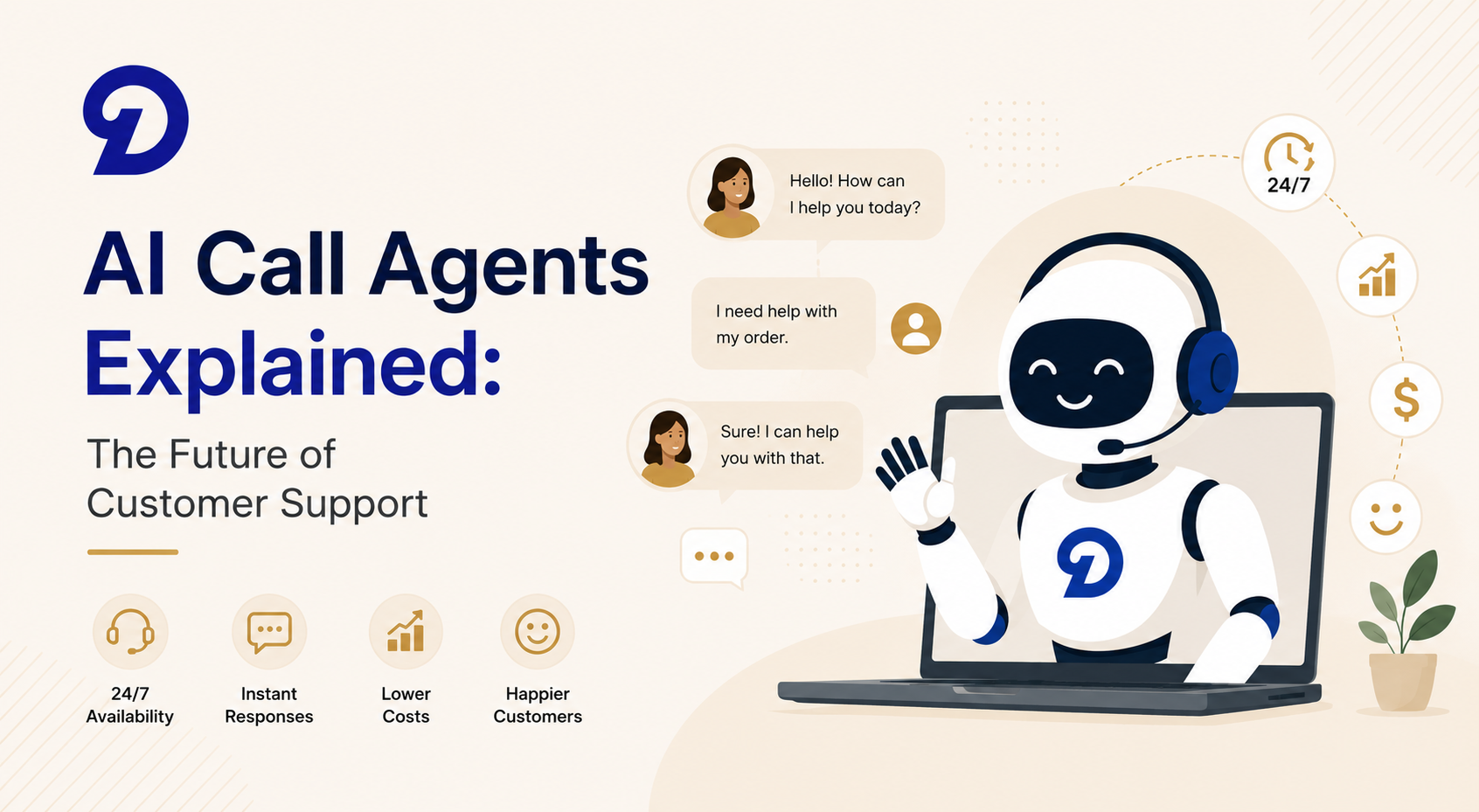
Customer support is no longer about hiring more agents, it’s about building smarter systems with AI agents that can handle conversations at scale.
For years, businesses have relied on human support teams to manage incoming calls, resolve issues, and maintain customer satisfaction. While this model has worked, it comes with clear limitations. Costs increase as call volume grows, response times become inconsistent, and scaling requires continuous hiring and training.
Today, that model is being redefined by a new approach: AI call agents.
These systems are not just automated responders. They are intelligent, conversational agents capable of understanding customer needs, responding naturally, and resolving issues in real time. As more businesses adopt this technology, customer support is shifting from a people-heavy function to a system-driven operation.
What Are AI Call Agents?
AI call agents are voice-based systems that can handle phone conversations with customers using artificial intelligence.
Unlike traditional automated systems that rely on rigid menus and scripted responses, AI call agents can understand natural language, interpret intent, and respond dynamically. This makes interactions feel less mechanical and more like speaking with a real person.
At a high level, an AI call agent listens to what a caller says, processes the meaning behind it, decides on the best response, and replies using a human-like voice. This entire process happens within seconds, creating a seamless conversational experience.
How AI Call Agents Actually Work
Behind the simplicity of a conversation lies a sophisticated system working in real time.
When a customer speaks, their voice is first converted into text through speech recognition technology. This text is then processed by a language model that analyzes the intent behind the message. The system determines what the user wants, whether it’s a question, a complaint, or a request for action.
Once the intent is understood, the AI decides how to respond. It may provide an answer, ask a follow-up question, or trigger a specific workflow such as booking an appointment or retrieving account information.
Finally, the response is converted back into speech using advanced voice synthesis tools like ElevenLabs, allowing the AI to speak in a natural and human-like tone.
This entire loop happens continuously throughout the call, enabling fluid, back-and-forth communication without noticeable delays.
FURTHER READING
➤ Will AI Replace Software Engineers?
Why Businesses Are Moving Toward AI Call Agents
The shift toward AI-powered support is driven by practical business needs rather than hype.
One of the biggest advantages is availability. AI call agents can operate around the clock without fatigue, ensuring that customers receive support whenever they need it. This alone significantly improves customer experience, especially for businesses with global audiences.
Cost is another major factor. Scaling a human support team requires ongoing investment in hiring, training, and management. AI systems, on the other hand, can handle thousands of interactions simultaneously without a proportional increase in cost.
Speed also plays a critical role. Customers today expect immediate responses, and long wait times often lead to frustration or lost opportunities. AI eliminates queues by responding instantly, keeping interactions smooth and efficient.
Beyond these operational benefits, AI also brings consistency. Every interaction follows a defined standard, reducing the variability that often comes with human-driven support. This leads to more predictable and reliable service delivery.
Real-World Applications of AI Call Agents
AI call agents are already being used across industries to handle a wide range of customer interactions.
In customer support, they manage common inquiries, troubleshoot basic issues, and provide instant answers to frequently asked questions. This reduces the workload on human agents and allows them to focus on more complex cases.
In appointment-based businesses, AI agents handle scheduling by checking availability, booking slots, and sending confirmations. This removes the need for manual coordination and minimizes errors.
They are also widely used in lead qualification. When potential customers call in, the AI can gather relevant information, understand their needs, and determine whether they are a good fit before passing them to a sales team.
In e-commerce and service industries, AI call agents provide order updates, delivery information, and account assistance, ensuring customers stay informed without requiring human intervention.
Where AI Still Needs Human Support
Despite its capabilities, AI is not a complete replacement for human interaction.
There are situations where emotional intelligence, empathy, and complex decision-making are required. In these cases, human agents remain essential. The most effective systems are designed with this in mind, allowing seamless escalation from AI to a human representative when necessary.
This hybrid approach ensures that efficiency does not come at the expense of quality. AI handles the majority of routine interactions, while humans step in where they add the most value.
The Shift from Support Teams to Support Systems
What we’re witnessing is a broader transformation in how businesses approach customer support.
Instead of asking how many agents are needed to handle call volume, companies are beginning to ask how they can build systems that manage interactions more intelligently. This shift changes support from a cost center into a scalable, strategic function.
AI call agents sit at the center of this transformation. They enable businesses to handle growth without the traditional constraints of staffing, while also improving the overall customer experience.
What This Means for Your Business
If your current support system relies entirely on human agents, there’s a high chance you’re facing challenges with cost, scalability, or response time.
AI call agents offer a way to address these challenges without sacrificing quality. By automating routine interactions and optimizing response workflows, businesses can operate more efficiently while delivering better service.
More importantly, they create a foundation for future growth. As customer expectations continue to evolve, having an intelligent support system in place becomes less of an advantage and more of a necessity.
You can explore this AI call agent system we built for Firstcall, using RetellAI, Twilio, Make and Monday.com.