
In the pursuit of software excellence, the most significant barriers to velocity are rarely found at the keyboard. For most high-growth organizations, the bottleneck isn’t how fast an engineer can write a function; it is the “glue work”; the reviews, the documentation, the environment setups, and the endless coordination required to move code from a local machine to a production environment. As we manage increasingly complex distributed systems, the “cognitive tax” on developers has reached a breaking point.
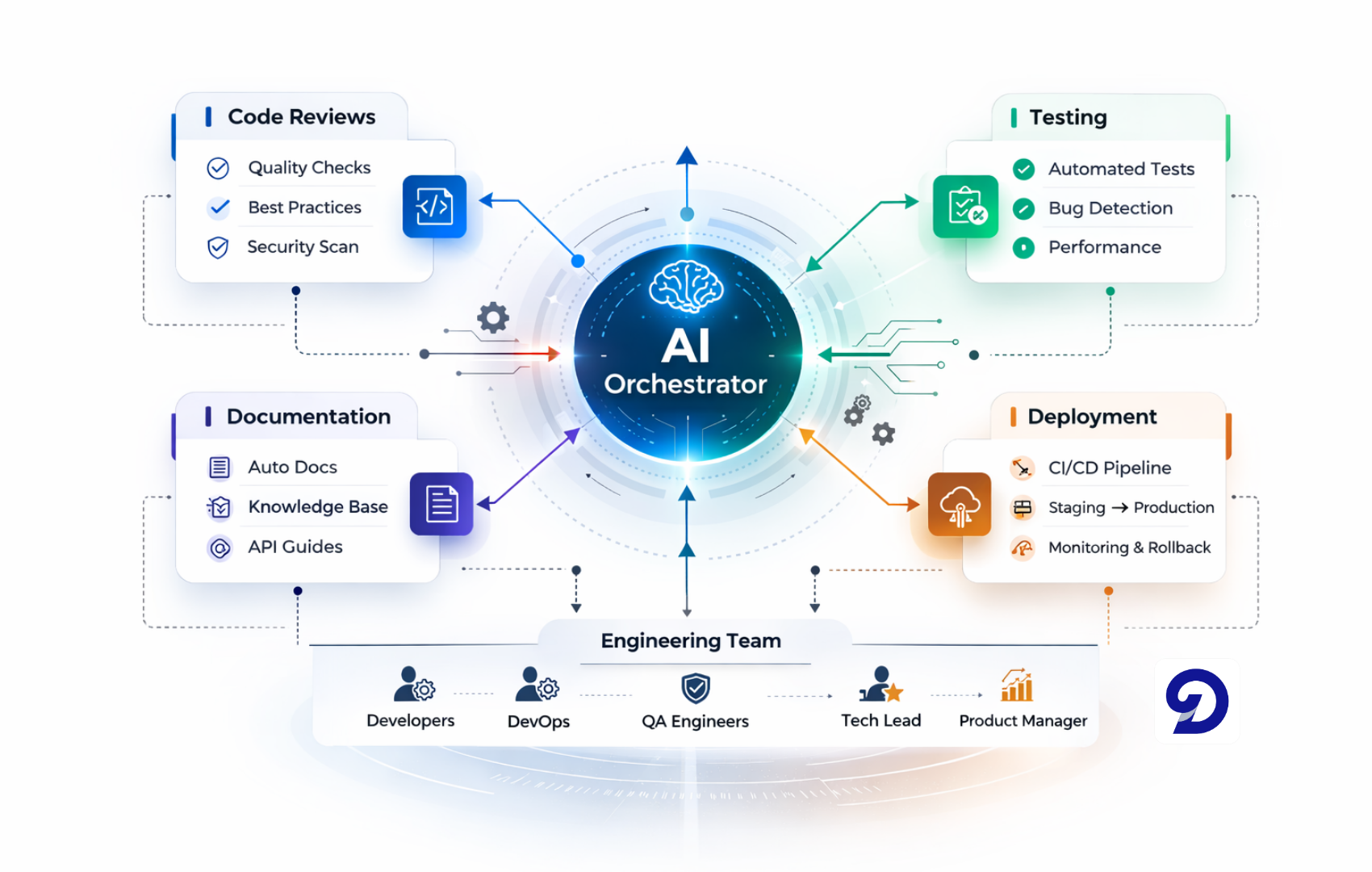
Traditional automation has focused on deterministic tasks—scripts that run when a specific trigger occurs. However, we are now witnessing a shift toward Agentic Workflows. Unlike standard Copilots that suggest code snippets, AI agents are autonomous entities capable of planning, executing, and refining multi-step tasks. At Doshby, we view the integration of these agents not just as a tool for writing code, but as a strategic solution for orchestrating the entire Software Development Lifecycle (SDLC). By offloading high-friction, low-creativity tasks to autonomous agents, engineering teams can finally return to what they do best: solving core business problems.
The Hidden Costs of Developer Friction
Before addressing the solution, we must quantify the problem. Engineering bottlenecks are rarely about slow typing; they are about “wait states.” According to the DORA (DevOps Research and Assessment) benchmarks, lead time for changes and change failure rates are the ultimate indicators of organizational health. In many mid-to-large enterprises, a piece of code might be “finished” by a developer in four hours, but it takes four days to pass through the gauntlet of human reviews, security scans, and staging deployments.
This delay is what we refer to as the “Cognitive Tax.” Every time a developer has to stop their creative work to review a 1,000-line PR or hunt down outdated documentation, they lose the “flow state” that is essential for complex problem-solving. McKinsey & Company has identified that high-velocity organizations see revenue growth four to five times faster than their peers, primarily by reducing this friction. AI agents serve as the automated lubricant for these high-friction touchpoints.
FURTHER READING
➤ How AI Agents Are Changing Software Engineering Workflows
Autonomous Code Reviews: Beyond Syntax Checking
The most persistent bottleneck in any agile team is the Pull Request queue. Human code reviews are essential for quality, but they are also the single greatest source of idle time. Senior engineers often find themselves acting as “human linters,” pointing out style inconsistencies, missing test cases, or obvious security vulnerabilities, tasks that are a poor use of their high-level expertise.
AI agents are now capable of acting as the “First Responder” in the code review process. Unlike static analysis tools that simply flag errors, an agent understands the context of the entire codebase. We are seeing teams implement agents that automatically review every PR for architectural consistency, performance regressions, and security flaws before a human ever sees the code. If the agent finds an issue, it doesn’t just flag it; it suggests and often applies the fix. This ensures that by the time a human reviewer enters the loop, the “low-level” work is already done, allowing the senior engineer to focus on high-level design and logic. This shift reduces the PR cycle time from days to hours.
The End of Documentation Debt
Documentation is the “technical debt” that no one wants to pay, yet it is the foundation of a scalable engineering culture. When documentation is missing or outdated, every new developer onboarding and every cross-team integration becomes a bottleneck. Traditionally, documentation has been a manual, secondary task that falls behind the moment code is pushed to production.
AI agents are solving this by treating documentation as a living byproduct of the development cycle. Agents can now monitor code changes in real-time and autonomously update README files, API specifications, and internal Wikis. More importantly, we are moving toward “Conversational Knowledge Bases.” Instead of a developer spending thirty minutes searching through Confluence or Slack for how a specific microservice handles authentication, an AI agent, trained on the company’s internal repos can provide the answer instantly with citations to the relevant code.
Managing Technical Debt and Migrations
One of the most soul-crushing bottlenecks for an engineering team is the “Legacy Migration”—updating a library across 200 microservices or migrating from one cloud provider’s API to another. These tasks are repetitive, error-prone, and can stall feature development for months.
Autonomous agents are uniquely suited for these “search and replace” tasks on steroids. An agent can be tasked with a goal: “Migrate all instances of Library X to Library Y, ensuring all unit tests pass.” The agent then systematically works through the codebase, creates the branches, modifies the code, runs the tests, and presents the completed work for a final human sign-off. This turns a three-month manual project into a three-day automated one. At Doshby, we help organizations identify these “high-toil” areas where agents can be deployed to reclaim hundreds of engineering hours.
Improving Developer Experience (DevEx)
While “velocity” is a business metric, “Developer Experience” (DevEx) is the cultural equivalent. Engineering bottlenecks don’t just slow down the product; they burn out the people. A developer who spends 60% of their time on administrative tasks and “unblocking” themselves is a developer who is looking for a new job.
AI agents act as a “Virtual SRE” or a “Platform Assistant” for every developer. Whether it’s auto-provisioning a development environment, triaging incoming bug reports to the correct owner, or summarizing long-running Slack threads into actionable Jira tickets, agents reduce the “managerial” burden on the individual contributor. When the “path to production” is clear and automated, developers feel more empowered and productive. This alignment of business goals (speed) and human goals (satisfaction) is the hallmark of a mature, AI-integrated engineering organization.