
Understanding One of the World’s Most Powerful Enterprise Technology Giants
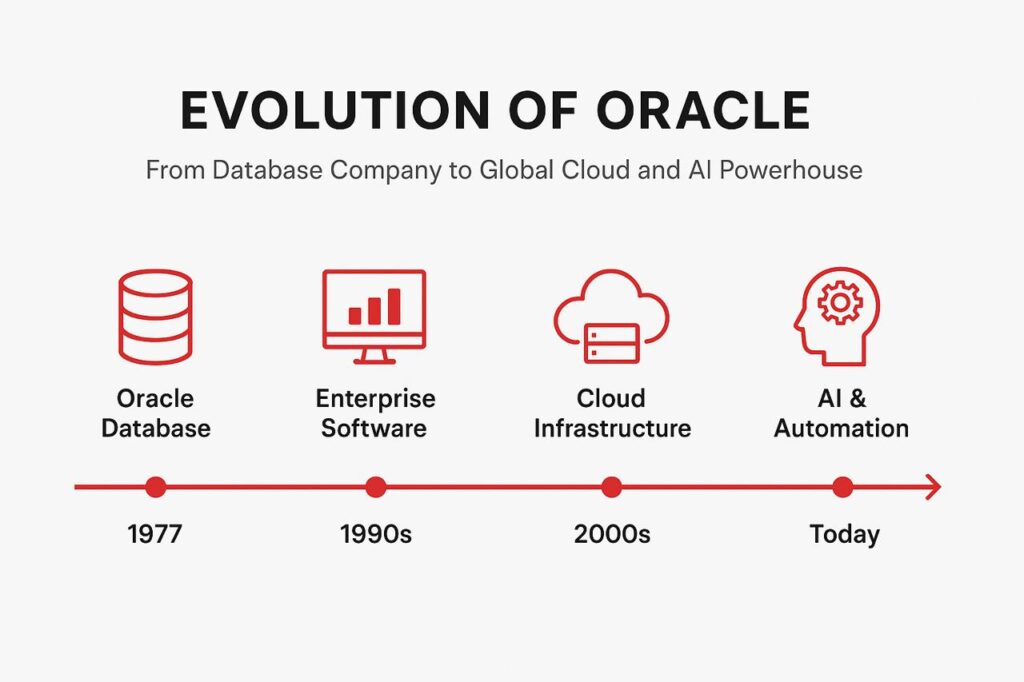
When most people hear “Oracle,” they think of databases and they wouldn’t be wrong. But that’s only a fraction of what Oracle Corporation represents today. Now, what does Oracle really do? Over the past four decades, Oracle has evolved from a database software provider into one of the world’s largest enterprise technology companies offering cloud infrastructure, business applications, cybersecurity solutions, and AI-driven analytics to millions of customers across the globe.
Founded in 1977 by Larry Ellison, Bob Miner, and Ed Oates, Oracle started with a bold vision: to create the world’s first commercially viable relational database. Their innovation transformed how organizations managed, stored, and retrieved data, setting a foundation for the modern data economy. Today, Oracle’s influence stretches across nearly every industry — from banking to healthcare, manufacturing to retail — empowering businesses to handle massive data workloads, automate operations, and make smarter decisions.
The Origins: From Database Pioneer to Enterprise Powerhouse
Oracle’s journey began under the name Software Development Laboratories (SDL) in 1977. Ellison and his co-founders were fascinated by a research paper on relational databases published by IBM’s Edgar F. Codd. They saw what IBM didn’t: the future of data management would depend on structured query language (SQL).
By 1979, Oracle released Oracle V2, the first commercial SQL-based relational database. It was revolutionary — for the first time, companies could easily query and manage large datasets without complex coding. This innovation helped Oracle rapidly dominate the enterprise software market. By the 1990s, it was powering financial systems, manufacturing operations, and telecommunications networks worldwide.
Ellison’s ambition went far beyond databases. He envisioned Oracle as the backbone of digital business — a company that could provide not just data storage, but the entire technological infrastructure enterprises needed to run and scale.
Oracle’s Core Businesses: More Than Just Databases
In reality, Oracle is far more than a database company. It’s a global powerhouse that powers the digital backbone of governments, banks, airlines, hospitals, and even emerging AI startups. Its technologies run quietly behind the scenes, ensuring that businesses operate, data flows securely, and innovations scale globally. Today, Oracle operates across four primary business pillars:
1. Cloud Infrastructure (OCI)
Oracle Cloud Infrastructure, or OCI, represents Oracle’s modern answer to Amazon Web Services (AWS), Microsoft Azure, and Google Cloud. Launched in 2016, OCI provides computing, networking, and storage services optimized for performance, security, and cost-efficiency.
Unlike its early competitors, OCI focuses heavily on enterprise-grade workloads — mission-critical databases, ERP systems, and analytics pipelines. Its key differentiator lies in its autonomous database technology, which uses machine learning to automatically patch, tune, and secure databases with minimal human intervention.
As of 2025, Oracle’s cloud revenue has grown substantially, driven by clients migrating from legacy systems to Oracle Cloud for scalability and cost savings. Major customers like Zoom and Toyota rely on OCI to manage large-scale workloads securely and efficiently.
2. Oracle’s Expansion into Applications
While databases remained Oracle’s bread and butter, the company soon realized that data alone wasn’t enough, businesses needed full-fledged applications to use that data effectively.
This led Oracle to create and acquire a range of enterprise software solutions:
- Enterprise Resource Planning (ERP) – Helping businesses manage finance, procurement, and operations.
- Customer Relationship Management (CRM) – Streamlining sales, marketing, and customer service.
- Human Capital Management (HCM) – Enabling organizations to recruit, train, and manage their workforce.
- Supply Chain Management (SCM) – Optimizing production, logistics, and inventory.
Each of these systems is integrated with Oracle’s powerful databases, creating a seamless ecosystem where data, analytics, and automation work hand in hand.
Through strategic acquisitions, such as PeopleSoft, Siebel Systems, and JD Edwards — Oracle solidified its position as a one-stop shop for enterprise software. Companies that once had to stitch together software from multiple vendors could now rely on Oracle for everything under one roof.
3. Database & Middleware Technologies
Oracle’s database technology remains its cornerstone. The Oracle Database 23c, its latest release, introduces AI integration, JSON document storage, and advanced automation capabilities.
Additionally, Oracle’s middleware stack — including WebLogic Server and Oracle Fusion Middleware, helps organizations build, connect, and secure enterprise applications. This layer enables companies to modernize legacy systems and create interoperable digital ecosystems.
4. AI and Autonomous Systems: Oracle’s Intelligent Leap
Oracle has quietly become one of the major players in AI-driven enterprise technologies. Its AI strategy isn’t about flashy consumer-facing products but about embedding intelligence directly into the enterprise stack.
Oracle integrates machine learning and automation into almost everything it offers:
- The Autonomous Database uses AI to self-heal and self-optimize.
- Oracle Fusion Applications embed AI features like expense prediction, HR automation, and intelligent analytics.
- The OCI AI Services allow businesses to build chatbots, automate workflows, and run computer vision or language models securely within Oracle Cloud.
Oracle’s strength lies in its enterprise-grade AI integration— not general-purpose models like OpenAI or Anthropic, but purpose-built intelligence for business operations. This focus on practicality makes Oracle indispensable for organizations looking to modernize without chaos.
FURTHER READING
➤ The Top 10 Largest AI Companies in 2025
How Oracle Makes Money
Oracle’s revenue streams are diversified across cloud services, software licensing, hardware, and consulting.
- Cloud Services & License Support: This category accounts for the majority of revenue, over 70% as of 2025.
- Cloud License & On-Premises Software: Still significant for hybrid clients who haven’t fully migrated.
- Hardware: Includes engineered systems like Exadata, used for high-performance computing.
- Services: Consulting, implementation, and customer support.
This model ensures Oracle continues to generate strong recurring revenue while transitioning to a cloud-first business.
Oracle’s Strategic Acquisitions
One key factor behind Oracle’s longevity is its aggressive acquisition strategy. The company has made over 140 acquisitions, strategically expanding into complementary technologies. Some of the most notable include:
- PeopleSoft (2005) – Strengthened Oracle’s position in ERP and HR software.
- Siebel Systems (2006) – Added powerful CRM capabilities.
- Sun Microsystems (2010) – Gave Oracle control of Java, MySQL, and the Solaris OS.
- Cerner (2022) – Marked a major move into healthcare technology and patient data analytics.
Each acquisition bolstered Oracle’s integrated stack, helping it offer end-to-end enterprise solutions that competitors often assemble through third parties.
Oracle Cloud Competitors & Global Impact
While AWS and Azure lead in market share, Oracle Cloud’s strength lies in performance, cost efficiency, and enterprise-grade security. OCI’s architecture offers predictable pricing, lower latency, and autonomous services that reduce manual workload.
Furthermore, Oracle’s focus on industry-specific cloud solutions such as Oracle Healthcare, Oracle Financial Services Cloud, and Oracle Hospitality — gives it a distinct edge in regulated sectors that demand reliability and compliance.
Oracle technologies underpin critical systems in over 175 countries, supporting sectors like banking, education, government, and energy. Governments use Oracle databases to secure citizen data; banks use them to process millions of transactions per second; and universities use them to analyze research data.
In Africa, Oracle’s initiatives include digital literacy programs and cloud innovation hubs that help local developers and businesses modernize their IT systems.
The Future of Oracle
Looking ahead, Oracle aims to become the AI-driven enterprise cloud of choice. Its roadmap focuses on expanding data centers, deepening AI integrations, and automating infrastructure to make enterprise computing self-managing and self-healing.
Its partnership with Nvidia to deliver AI infrastructure and GPU-accelerated cloud computing is positioning Oracle as a key player in the generative AI revolution. With this, Oracle is not just keeping up — it’s reasserting itself as a pioneer in intelligent enterprise technology.
Oracle’s Enduring Legacy
So, what does Oracle really do? It powers the enterprise world — providing the tools, platforms, and intelligence that modern organizations rely on. From databases and applications to AI and cloud infrastructure, Oracle’s ecosystem touches every corner of the digital economy.
Its legacy isn’t just in code or cloud capacity, it’s in the trust businesses place in its systems to keep their world running. As Oracle continues investing in AI, automation, and next-gen cloud technologies, one thing is certain: it remains one of the few companies truly defining the future of enterprise computing.
Thinking about integrating Oracle Cloud or database solutions into your business?
At Doshby, we help organizations modernize their infrastructure, migrate to cloud platforms, and harness automation to reduce costs and improve performance.
Get in touch with our experts today to discuss your Oracle-powered digital transformation.