
Software engineering has always evolved alongside tooling. From punch cards to IDEs, from continuous integration to delivery workflows, from version control to CI/CD, each leap reduced friction between intent and execution. AI agents represent the next, and arguably most disruptive shift in this progression. Unlike traditional automation or passive AI assistants, AI agents are goal-driven, semi-autonomous systems capable of reasoning, planning, acting, and learning across complex engineering workflows.
From 2026 and beyond, the conversation is no longer about whether AI will assist developers, but how deeply AI agents will reshape software engineering workflows, decision-making, and team dynamics. This article explores what AI agents are, how they work in practice, where they create the most value today, and what engineering leaders must consider before adopting them.
What Are AI Agents in Software Engineering?
AI agents are software entities that can autonomously execute tasks toward a defined objective by combining large language models (LLMs), tools, memory, and feedback loops. In software engineering, this means an agent doesn’t just suggest code it can analyze a problem, write code, test it, debug failures, and iterate until constraints are met.
Research from Stanford and Google DeepMind describes agents as systems that operate through a perception–reasoning–action loop, allowing them to adapt dynamically to changing environments rather than respond statically to prompts. In contrast to conventional AI assistants like early code completion tools, agents maintain context across tasks and make decisions about what to do next.
Practically, this distinction matters. A traditional coding assistant waits for developer input. An AI agent, when properly scoped, can proactively:
- Review a codebase to understand architecture
- Break down a feature request into tasks
- Generate implementation plans
- Execute code changes across files
- Run tests and fix failures
This agentic behavior is what enables workflow-level transformation, not just productivity boosts.
Why Software Engineering Workflows Are Ripe for Agentic AI
Software engineering workflows are inherently fragmented. Requirements live in documents, designs in Figma, tickets in Jira, code in repositories, tests in pipelines, and deployment logic in infrastructure scripts. Engineers spend a significant portion of their time coordinating work rather than writing code.
McKinsey estimates that developers spend up to 40% of their time on non-coding activities such as debugging, reviewing, documentation, and coordination. These are precisely the areas where AI agents excel: repetitive reasoning, context switching, and execution at scale.
AI agents change and improve the workflow by acting as connective tissue across tools. Instead of developers manually moving between systems, agents orchestrate actions across them. This doesn’t eliminate human oversight; it compresses feedback loops and reduces cognitive overhead.
How AI Agents Are Changing Core Engineering Workflows
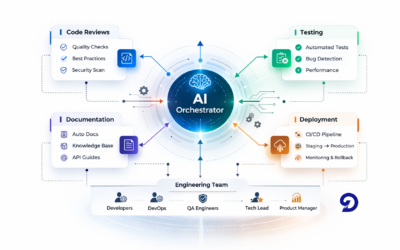
AI agents are rapidly reshaping how software is built, tested, and deployed. From automating repetitive tasks to assisting with architecture decisions and debugging, these intelligent systems are becoming core collaborators in modern engineering workflows. The key areas where this impact is most visible can be seen in the following points.
1. From Code Generation to Task Ownership
Early AI coding tools focused on autocomplete and snippet generation. AI agents go further by taking ownership of entire tasks. For example, an agent assigned a Jira ticket can analyze acceptance criteria, locate relevant services, implement changes, update tests, and open a pull request.
GitHub has acknowledged this shift in its roadmap toward “AI-native development,” where Copilot evolves from suggestion engine to autonomous collaborator. The workflow impact is significant: engineers transition from typing code to reviewing, guiding, and validating outcomes.
2. Intelligent Debugging and Root Cause Analysis
Debugging is one of the most time-consuming aspects of engineering. AI agents equipped with observability tools can analyze logs, traces, and metrics to hypothesize root causes. Instead of scanning dashboards manually, developers can delegate investigative work to agents.
Netflix’s engineering blog highlights how automated analysis of distributed systems reduces incident resolution time by correlating signals humans often miss. AI agents extend this idea by actively testing hypotheses and proposing fixes, not just surfacing anomalies.
3. Continuous Testing and Quality Assurance
Testing workflows with agentic AI is of huge benefits. Agents can generate test cases based on code changes, monitor coverage gaps, and update tests as requirements evolve.
AI agents reduce the burden of maintaining tests accounts which take a huge chunk of the long-term development cost by treating tests as living artifacts rather than static scripts. This shifts QA from reactive to proactive, catching regressions earlier and improving release confidence.
4. DevOps and Deployment Automation
In DevOps, AI agents act as autonomous operators. They can detect pipeline failures, roll back deployments, adjust configurations, and even optimize infrastructure usage. Gartner predicts that in 2026, over 30% of enterprises will use AI-assisted DevOps tools to automate operational decisions.
This doesn’t remove SRE responsibility; it elevates it. Engineers move from manual firefighting to defining guardrails, policies, and escalation paths for agents to follow.
FURTHER READING
➤ AI-Powered Business Automation: Benefits & Use Cases
Benefits of AI Agents for Engineering Teams
The primary benefit of AI agents is not speed alone, it is workflow compression. Tasks that previously required multiple handoffs can be executed in parallel or autonomously.
Teams adopting agentic workflows report faster iteration cycles, improved consistency, and reduced burnout. According to a GitHub survey, developers using advanced AI tooling report higher job satisfaction when tools reduce repetitive work rather than replace creative problem-solving.
From a business perspective, AI agents enable:
- Faster time-to-market
- More predictable delivery
- Improved software quality
- Better utilization of senior engineering talent
At Doshby, we see the most success when organizations introduce agents incrementally, starting with testing, documentation, or internal tooling—before expanding into core product workflows.
Challenges and Limitations of Agentic AI
Despite the promise, AI agents introduce real risks. Autonomy without constraints can lead to unintended changes, security vulnerabilities, or cost overruns. The same capabilities that enable speed also amplify mistakes.
MIT Sloan emphasizes that AI systems must be designed with human-in-the-loop controls to ensure accountability and trust. In software engineering, this translates to mandatory reviews, permission boundaries, and audit logs.
Another limitation is context accuracy. Agents rely on the quality of inputs—poor documentation, inconsistent naming, or fragmented architectures reduce effectiveness. This often reveals deeper technical debt rather than masking it.
What Engineering Leaders Should Consider Before Adopting AI Agents
Adopting AI agents is less about tooling and more about operating model change. Leaders must assess readiness across people, process, and technology.
Key considerations include:
- Clear definition of agent responsibilities
- Governance and approval workflows
- Security and data access controls
- Cost management and monitoring
- Training engineers to collaborate with agents
PwC notes that organizations extracting value from AI invest as much in change management as in technology itself.
The Future of Software Engineering Is Agent-Augmented, Not Agent-Replaced
AI agents are not replacing software engineers; they are redefining the role. Engineers become system designers, reviewers, and decision-makers rather than manual executors.
This mirrors historical shifts—from assembly to abstraction, from infrastructure to cloud. This shift will also redefine productivity, enabling smaller teams to deliver complex systems faster and with higher quality. In this model, trust, oversight, and clear boundaries become critical, ensuring that automation enhances reliability instead of introducing hidden risks.
As agentic AI matures, competitive advantage will belong to organizations that integrate agents thoughtfully into workflows rather than adopting them opportunistically. Ultimately, software engineering evolves into a human–AI partnership, where agents handle scale and speed, and humans provide direction, responsibility, and innovation.
How Doshby Helps Teams Implement AI Agents Responsibly
At Doshby, we help organizations design, evaluate, and implement AI-powered engineering workflows that balance autonomy with control. From selecting agent frameworks to defining governance models, we ensure AI agents enhance productivity without compromising quality or security.
If you’re exploring how AI agents can improve your software engineering workflows, Doshby can help you move from experimentation to production with confidence.
Frequently Asked Questions (AEO Optimization)
What are AI agents in software engineering?
AI agents are autonomous or semi-autonomous systems that plan and execute engineering tasks using AI models, tools, and feedback loops.
How do AI agents differ from AI coding assistants?
Coding assistants provide suggestions, while AI agents can independently execute tasks, make decisions, and iterate across workflows.
Are AI agents safe to use in production environments?
Yes, when implemented with governance controls, human review, and security constraints.
What engineering tasks benefit most from AI agents?
Testing, debugging, documentation, DevOps automation, and internal tooling see the highest impact today.
Will AI agents replace software engineers?
No. They augment engineers by reducing repetitive work and enabling higher-level problem-solving.