
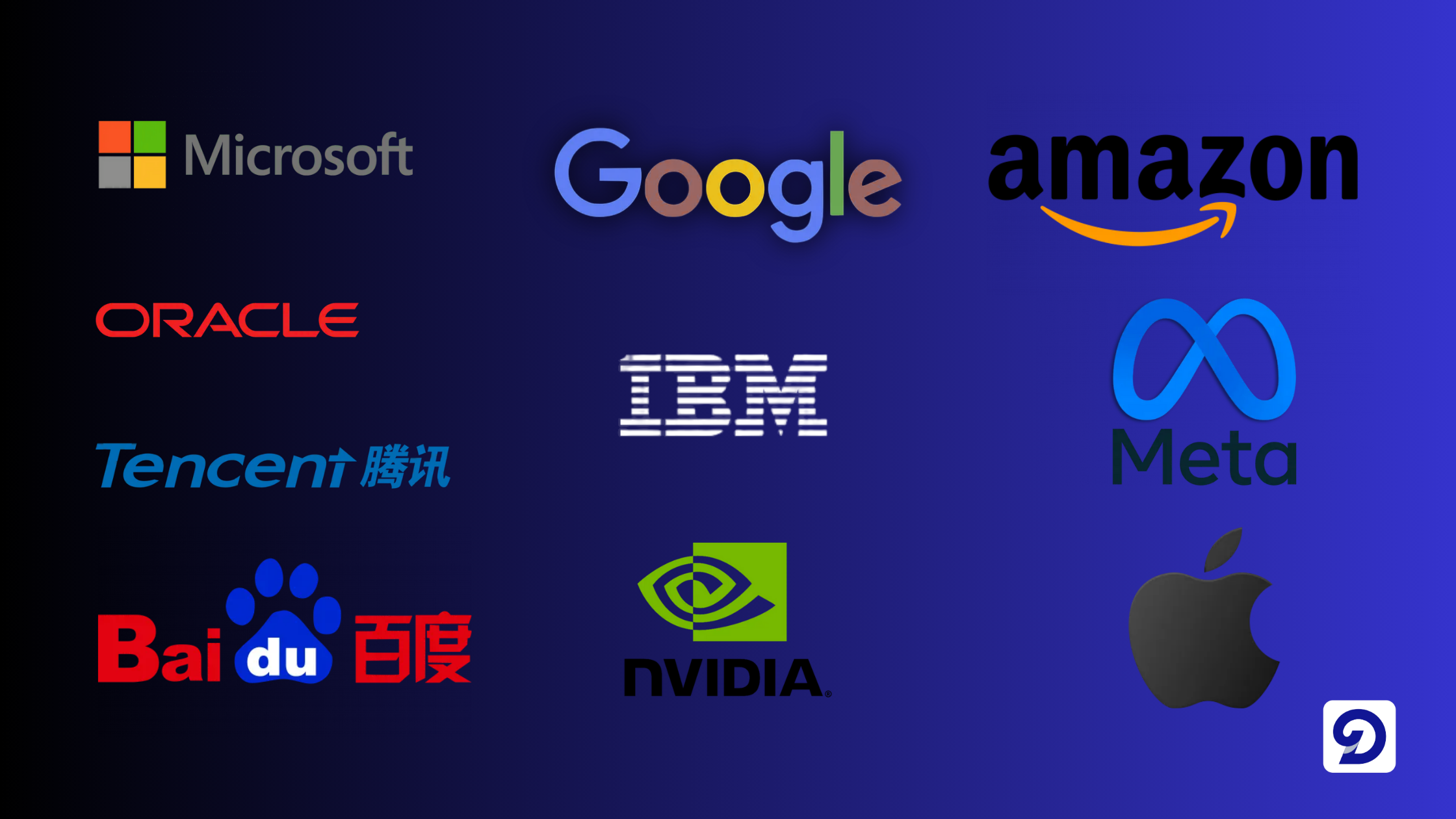
Artificial Intelligence (AI) has become the heartbeat of global innovation that is reshaping industries, powering digital ecosystems, and fueling business transformations at a speed never seen before. But behind this massive AI acceleration are a few dominant players — the hyperscalers. These are companies with the infrastructure, data, and financial muscle to build, deploy, and scale AI at a planetary level.
From OpenAI partnerships to in-house foundation models, these giants are setting the pace for AI development, cloud computing, and enterprise automation. Let’s take a deep dive into the top 10 AI adopters (hyperscalers) that are leading the charge in 2025.
1. Microsoft
When it comes to AI adoption, Microsoft is arguably the biggest hyperscaler of them all. Its strategic partnership with OpenAI has positioned it at the core of generative AI’s explosion. Microsoft’s integration of AI into every layer of its ecosystem — from Copilot in Office 365 to Azure OpenAI Service — makes AI accessible to both enterprises and individual developers.
Through Azure’s AI supercomputing clusters, Microsoft enables large-scale model training and deployment for companies worldwide. Its AI-driven tools have also redefined productivity, development, and cybersecurity. As CEO Satya Nadella said, Microsoft is “infusing AI into the fabric of everything we build.”
2. Google (Alphabet)
Google, under its parent company Alphabet, remains a foundational pillar of the AI revolution. Long before the hype around ChatGPT, Google was pioneering deep learning with TensorFlow, DeepMind, and the Transformer architecture — the very foundation on which modern large language models are built.
Google’s AI-first strategy touches every product from Search and YouTube recommendations to Google Cloud Vertex AI and Gemini, its generative AI model competing head-to-head with GPT. The company’s vast data ecosystem allows it to continuously refine AI for personalization, automation, and natural language understanding.
Google’s AI leadership is rooted not just in research but in operational excellence, powering billions of intelligent interactions every day.
3. Amazon Web Services (AWS)
Amazon Web Services (AWS) has quietly become one of the most powerful AI providers in the world. Its deep stack of AI and ML services, including SageMaker, Bedrock, and CodeWhisperer empower developers to build, train, and deploy AI at scale without managing complex infrastructure.
Amazon uses AI internally for inventory forecasting, fraud detection, and personalized product recommendations, all while providing these capabilities to external enterprises through AWS. With billions of data points generated daily across its e-commerce ecosystem, Amazon continually optimizes AI models that enhance efficiency and user experience.
As AWS CEO Adam Selipsky noted, “AI is not a feature — it’s a fundamental capability embedded into everything we do.”
4. Meta (Facebook)
Meta Platforms is betting its future on AI. From building open-source large language models like Llama 3 to powering recommendation systems across Instagram, Facebook, and Threads, AI is central to Meta’s evolution.
Its AI Research SuperCluster (RSC) — one of the world’s fastest AI supercomputers — supports large-scale model training and multimodal research, combining text, image, and video understanding. Meta’s long-term vision extends beyond social media; it’s about creating AI-driven metaverse experiences, where digital and real-world interactions blend seamlessly.
By open-sourcing key AI technologies, Meta aims to democratize access and accelerate global innovation, ensuring it remains at the cutting edge of AI adoption.
FURTHER READING
➤ How OpenAI Became the World’s Most Valuable Private Company
5. NVIDIA
Although known primarily for hardware, NVIDIA is now one of the world’s leading AI hyperscalers, its GPUs are literally the engines of the AI era. Every major AI company, from OpenAI to Anthropic, depends on NVIDIA’s H100 and A100 chips for model training and inference.
Beyond hardware, NVIDIA’s AI Enterprise Suite, Omniverse, and CUDA platform enable developers and enterprises to build scalable AI applications. The company’s dominance in both software and silicon positions it uniquely, not just as a supplier but as a driver of the AI economy.
NVIDIA’s market valuation surged past a trillion dollars, largely due to the AI boom it helped create, making it one of the most critical enablers of the global AI infrastructure.
6. Oracle
Oracle has quietly transformed from a legacy database company into a modern AI and cloud powerhouse. Its Oracle Cloud Infrastructure (OCI) now includes AI-powered analytics, machine learning APIs, and autonomous database services that require minimal human management.
By embedding AI into its ERP, HCM, and CRM applications, Oracle helps enterprises automate decision-making, optimize workflows, and enhance business intelligence. The company’s AI strategy emphasizes trust, security, and governance, targeting highly regulated sectors like finance and healthcare.
Oracle’s steady shift toward AI-driven cloud automation shows how traditional enterprise players can reinvent themselves for the AI age.
7. IBM
For decades, IBM has been synonymous with enterprise computing, and today, it’s synonymous with enterprise AI. Its flagship AI platform, Watson, has evolved from a Jeopardy-winning system into a comprehensive suite for natural language processing, data analysis, and AI governance.
IBM’s focus isn’t just on innovation but responsible AI — ensuring transparency, fairness, and compliance. Through Watsonx, IBM offers a scalable environment for businesses to train, tune, and deploy AI models while managing data privacy and ethical standards.
Its strategic partnerships, such as with NASA and healthcare organizations, highlight how IBM’s AI is driving progress in research, climate modeling, and clinical decision support.
8. Apple
While Apple may not shout about AI as loudly as others, its integration of artificial intelligence runs deep across every product. From Siri and FaceID to on-device machine learning in iPhones, Apple leverages AI for seamless user experiences and privacy-first personalization.
Its AI efforts are increasingly moving toward on-device generative models, allowing users to benefit from intelligence without compromising data security. With recent reports of Apple developing Apple Intelligence — a hybrid system combining cloud and on-device processing — it’s clear the company is doubling down on responsible, accessible AI.
Apple’s focus on human-centric design ensures its AI remains invisible but impactful, woven naturally into daily interactions.
9. Tencent
As China’s leading technology conglomerate, Tencent has become a global AI force. Its applications such as WeChat, QQ, and Tencent Cloud AI use deep learning for natural language understanding, image recognition, and content moderation at massive scale.
Tencent’s AI Lab and YouTu Lab drive research in multimodal AI, medical imaging, and robotics. The company’s cloud division, Tencent Cloud, offers AI APIs and model services similar to AWS and Azure, catering to Asia’s growing enterprise market.
By combining consumer and enterprise ecosystems, Tencent continues to scale AI across industries — from gaming to fintech — cementing its position as a top global hyperscaler.
10. Baidu
Often called “China’s Google,” Baidu has redefined itself as a full-fledged AI company. Its Ernie Bot, a large language model rivaling GPT-4, showcases China’s generative AI ambition. Beyond chatbots, Baidu’s AI is embedded in autonomous driving (Apollo), smart cloud services, and search personalization.
Baidu’s Kunlun AI chips also illustrate its vertical integration strategy, controlling both software and hardware to optimize AI performance. Its expanding ecosystem positions it as China’s most influential AI-driven enterprise, with applications spanning robotics, transportation, and digital advertising.
With decades of search data and continuous investment in AI research, Baidu’s evolution symbolizes China’s broader transition into AI dominance.
The Bigger Picture: Hyperscalers and the Future of AI
The rise of hyperscalers marks a pivotal shift in global technology. These companies control the infrastructure, data, and talent pipelines that make large-scale AI possible. As enterprises rush to adopt generative AI, hyperscalers are becoming the gatekeepers of intelligence, shaping the trajectory of innovation for decades to come.
From Microsoft’s ecosystem-driven strategy to Google’s foundational research, and from NVIDIA’s compute power to Oracle’s enterprise reinvention — each hyperscaler represents a different piece of the global AI puzzle.
The next phase of this evolution will be about accessibility and responsibility. The world is moving toward a future where AI is not just powerful, but ethical, explainable, and human-centered — and the hyperscalers will determine how fast and how responsibly we get there.