
In the world of software development, few debates are as timeless , or as critical as microservices vs monolith. Both architectural patterns have built billion-dollar platforms, from early Amazon’s monolith to Netflix’s distributed system of services. Yet, the choice between the two is rarely black and white.
At Doshby, we’ve seen startups and enterprises alike grapple with this decision. Choosing the wrong architecture early on can lead to technical debt, scaling issues, or spiraling costs later. But with the right foundation, your app can evolve seamlessly as your business grows.
Monoliths offer simplicity and speed, while Microservices promise flexibility and scalability. But which one truly fits your next software project? Let’s unpack both sides and see which approach fits.
What Is a Monolithic Architecture?
A monolithic application is built as a single, unified codebase. All its modules including authentication, payment, product management, and notifications are interconnected and deployed together.
Think of it as a single apartment building: all the rooms share the same plumbing, wiring, and main door. You can walk between rooms easily, but if the foundation cracks, the whole structure feels it.
Early versions of LinkedIn, Twitter, and Shopify started as monoliths, because it’s simpler to build and deploy when your product is just finding its feet.
The Case for Monoliths: Why Simplicity Still Wins (Sometimes)
The monolithic model has stood the test of time because it offers speed, simplicity, and cohesion, especially for early-stage teams.
- Faster initial development: When you’re building your MVP, you don’t want to spend months configuring APIs or orchestrating microservices. A single codebase helps you move fast.
- Easier debugging: All logic lives in one place, making it easier to trace errors or performance issues.
- Lower infrastructure cost: You don’t need multiple servers or complex DevOps setups — perfect for startups conserving cash.
A trading startup we worked with at Doshby initially launched their transaction system as a monolith. The architecture allowed them to go live in under 60 days, test their user flow, and attract investors before investing in a microservices migration later.
However, monoliths start to show cracks when scalability and independence become priorities.
What Are Microservices?
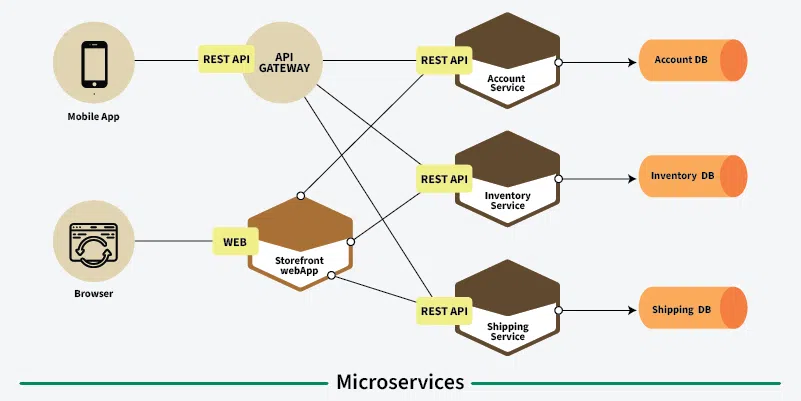
Microservices architecture breaks an application into independent, loosely coupled services, each responsible for a specific business function.
If a monolith is an apartment building, microservices are a neighborhood of houses — each with its own plumbing and power supply. They can grow, renovate, or even be rebuilt independently without disturbing the rest.
This is how companies like Netflix, Amazon, and Uber scale efficiently. When Netflix needs to improve recommendations, it doesn’t touch the entire system — it just updates the recommendation service.
The Case for Microservices
Microservices shine when your application starts attracting thousands of users or when your development team grows beyond a small unit. The most common pros to building your software on a Microservices architecture are
- Scalability: Each service can scale independently based on demand. For example, your checkout service might handle 10x more traffic than your admin dashboard.
- Technology flexibility: Teams can use different languages or frameworks for different services — Python for data processing, Node.js for APIs, etc.
- Resilience: If one service fails, others continue to operate — minimizing downtime.
HunuuHealth, a global healthcare client of Doshby recently shifted from a monolith to microservices. The result? Their deployment time dropped from hours to minutes, and downtime decreased by over 70%.
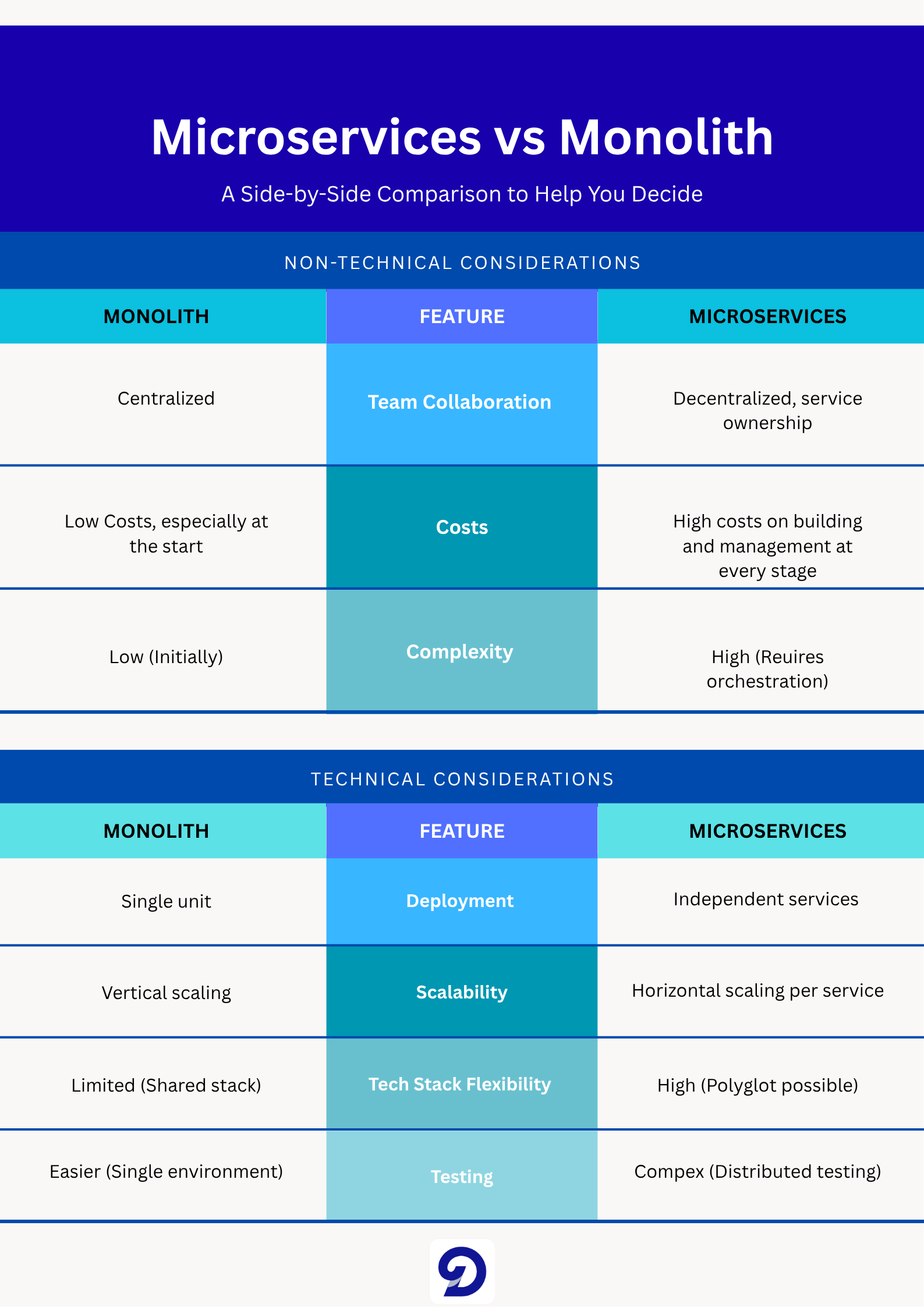
Side-by-side Comparison
| Feature | Monolith | Microservices |
| Complexity | Low (initially) | High (requires orchestration) |
| Deployment | Single unit | Independent services |
| Scalability | Vertical scaling | Horizontal scaling per service |
| Team Collaboration | Centralized | Decentralized, service ownership |
| Tech Stack Flexibility | Limited (Shared stack) | High (Polyglot possible) |
| Testing | Easier (Single environment | Complex (Distributed testing) |
| Failure Isolation | Poor (One bug can crash everything) | Strong (Failures contained) |
| Speed to Launch | Fast (Less setup) | Slower (More infrastructure needed) |
The Trade-Offs: Microservices vs Monolith
While microservices are powerful, they bring complexity, meaning that you trade simplicity for scalability.
Each service must communicate via APIs, which means network latency, versioning issues, and DevOps overhead.
Monitoring, testing, and deploying across multiple services require a mature engineering process — something startups often underestimate.
Even Amazon faced “microservice sprawl” at one point — hundreds of small services becoming difficult to coordinate. That’s why we often recommend a hybrid approach: start monolithic, then evolve into microservices as product-market fit solidifies.
When to Choose a Monolith
A monolith is ideal when:
- You’re building an MVP or early-stage product.
- Your team is small (under 10 developers).
- You prioritize speed to market over future flexibility.
- Your system complexity is low (e.g., a simple SaaS dashboard, eCommerce prototype, or internal tool).
Example: Slack started as a monolithic Ruby on Rails app. It wasn’t until usage skyrocketed that they began extracting critical services.
If your product is still in the “test and validate” phase, don’t overengineer it. At Doshby, we help startups build scalable monoliths — designed with a clear migration path toward microservices when the time comes.
When to Choose Microservices
Microservices are ideal when:
- Your app handles high transaction volumes or complex workflows.
- You have multiple development teams or plan to scale globally.
- You need independent deployment cycles (e.g., frequent feature releases).
- You require strong fault isolation for mission-critical systems (like fintech or healthtech apps).
Example: Netflix’s streaming service runs on hundreds of microservices. Each one manages a distinct function — playback, authentication, recommendations — allowing the platform to scale across millions of users simultaneously.
For established businesses or enterprise clients, Doshby helps design microservice-ready infrastructures leveraging cloud-native tools like AWS Lambda, Docker, and Kubernetes.
FURTHER READING
➤ Software Budgeting in 2025 – How to Plan and Estimate your Software Development Costs
Decision Framework
Still unsure? Use this checklist
| Question | If YES, Consider |
| You’re building an MVP | Monolith |
| Is your team small (<10 devs)? | Monolith |
| Do you need to launch qucikly? | Monolith |
| Is your app domain simple and narrow? | Monolith |
| Will your app scale across domains? | Microservices |
| Do you have multiple dev teams? | Microservices |
| Is CI/CD a priority? | Microservices |
| Do you expect frequent feature changes? | Microservices |
Cost and Time Implications
The hidden factor behind architecture choice is cost.
Building microservices can be 30–50% more expensive initially, not because of the code, but the infrastructure and orchestration complexity — load balancing, API gateways, CI/CD pipelines, etc.
By contrast, a monolith is leaner upfront but can incur long-term costs when scaling or updating becomes cumbersome.
This is why Doshby’s consulting process often begins with a scalability audit — helping businesses understand whether their traffic and operational goals justify microservices right now or later.
FURTHER READING: Software Budgeting in 2025 – How to Plan and Estimate your Software Development Costs
The Hybrid Approach: Best of Both Worlds
Many successful platforms don’t strictly choose one over the other. They adopt a modular monolith — a middle ground where codebases are structured like microservices but deployed together.
This allows teams to start fast and gradually decouple components when scaling demands it. It’s a path Doshby recommends for clients who want agility now and flexibility later.
Making the Right Choice
The question isn’t whether microservices are better than monoliths — it’s whether they’re right for your current stage of growth.
If you’re an early-stage startup, then build a monolith that scales, if you’re an enterprise battling downtime and team silos, move toward microservices.
At Doshby, we help businesses evaluate their technical maturity, forecast scalability needs, and design architectures that align with business goals — not just engineering trends.
Every successful app — from Stripe to Shopify — has faced the microservices vs monolith question at some point. What separates success stories from stalled projects isn’t the architecture itself, but how intentionally it was chosen and evolved.
If you’re planning your next software project and unsure which direction to take, we can help you assess your system needs, design your architecture roadmap, and build with long-term scalability in mind. Schedule an appointment with us today to learn how we design and build modern software solutions that evolve with your business.