
The Build-or-Assemble Dilemma Modern Businesses Face
Every growing business eventually reaches a familiar crossroads. You’ve identified a process that needs software support — maybe a customer portal, internal dashboard, workflow automation, or even a full digital product. The pressure to move fast is real. Budgets are finite. Stakeholders want results yesterday.
And then the question comes up:
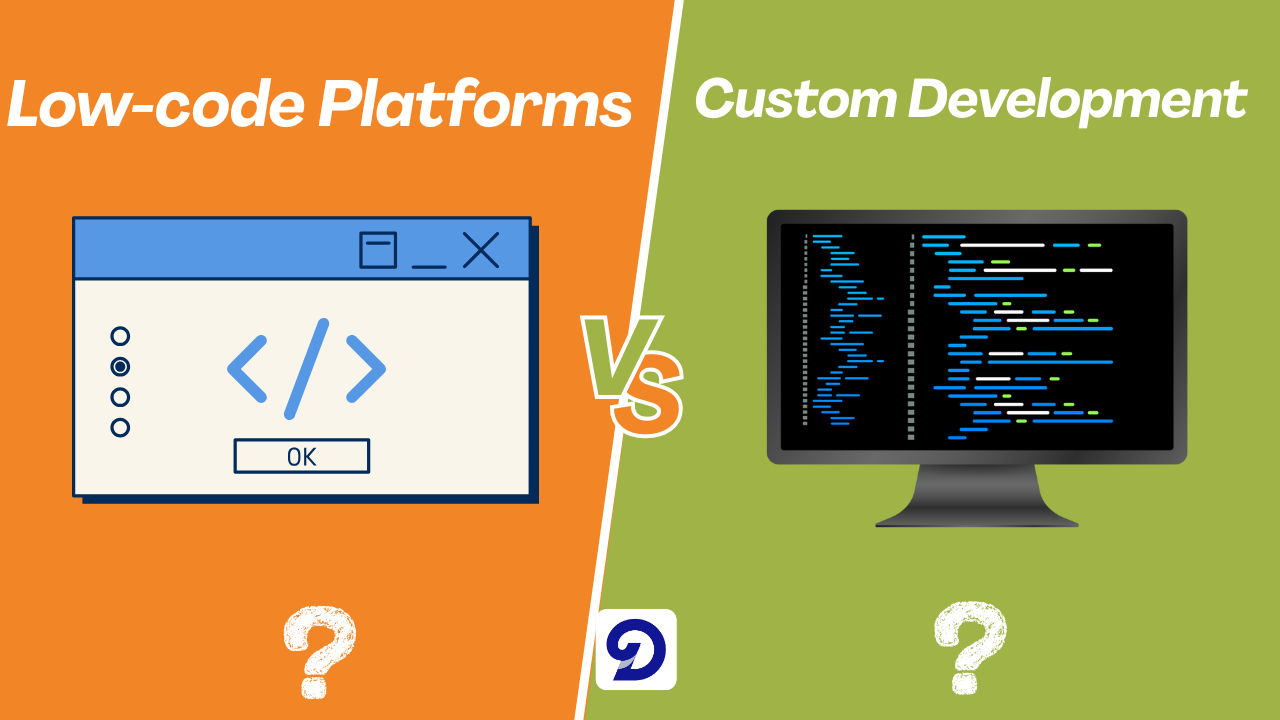
Should we use a low-code platform to build this quickly, or invest in fully custom software development? This isn’t just a technical decision. It’s a strategic business choice that impacts scalability, cost, security, long-term flexibility, and even competitive advantage.
Low-code platforms promise speed and accessibility. Custom development promises control and precision. Both approaches are valid — but only when aligned with the right business context. As organizations accelerate digital transformation, Gartner predicts that over 70% of new enterprise applications will be built using low-code or no-code technologies by 2026. Yet at the same time, demand for custom-built platforms continues to rise, especially in regulated, high-scale, or differentiation-driven industries.
In this article, we’ll break down how low-code and custom development really compare, where each approach excels, where they fall short, and how business leaders should think about choosing the right path — not just for today, but for the future.
What Are Low-Code Platforms? A Business-First Explanation
Low-code platforms are development environments that allow applications to be built using visual interfaces, drag-and-drop components, and pre-configured logic, with minimal hand-written code. Popular low-code platforms include OutSystems, Mendix, Microsoft Power Apps, Appian, and Retool.
From a business perspective, low-code exists to solve one primary problem; Software demand is growing faster than engineering capacity. Instead of writing everything from scratch, teams assemble applications using reusable building blocks. Developers can still write custom code when needed, but much of the work is abstracted away.
This abstraction dramatically reduces development time. According to Forrester, low-code platforms can accelerate application delivery by up to 10x compared to traditional development.
In practice, low-code platforms are often used to:
- Rapidly prototype ideas
- Build internal tools
- Automate workflows
- Create departmental apps
- Extend existing enterprise systems
But speed always comes with trade-offs — and understanding those trade-offs is critical.
What Is Custom Software Development?
Custom development is the traditional approach to building software. It represents the opposite end of the spectrum. Instead of assembling pre-built components, teams design and engineer systems from the ground up using frameworks, architectures, and technologies chosen specifically for the business context. This means that the designing, engineering, testing, and deploying applications are implemented from the ground up
This development approach gives organizations complete control over system behavior, give them full ownership of the codebase and IP, afford stakeholders and development team flexibility in architecture and integrations, while ensuring freedom from platform lock-in.
Custom development is how companies like Netflix, Uber, Stripe, and Shopify built their core platforms, making their software their competitive advantage.
From a product management perspective, custom development is not just about writing code. It’s about:
- Translating business strategy into technical architecture
- Designing for scale, performance, and security
- Building systems that evolve with the organization
Naturally, this comes with higher upfront investment — but often delivers stronger long-term returns when software plays a central role in the business.
Speed Versus Longevity: The Core Trade-Off
At its core, the low-code versus custom development debate is about time horizons. Low-code platforms optimize for immediate delivery. They are exceptionally effective when requirements are relatively stable and the primary goal is speed. Custom development, by contrast, optimizes for durability and strategic alignment over years rather than months.
This difference becomes clear when software requirements evolve. Low-code solutions perform best when the problem space is well understood and unlikely to change dramatically. Custom-built systems are better suited to environments where complexity grows over time, integrations multiply, and performance demands increase.
For this reason, many mature organizations adopt a blended approach—using low-code for internal tooling and operational workflows, while reserving custom development for customer-facing platforms and core systems.
FURTHER READING
➤ Custom Shift Management Software: Streamline Scheduling & Real-Time Alerts for Smarter Operations
The Business Benefits of Low-Code Platforms
Low-code platforms have gained massive adoption for good reason. When used correctly, they deliver tangible business value.
1. Faster Time-to-Market: Low-code dramatically compresses development cycles. What might take months in a traditional environment can often be delivered in weeks — or even days. For business teams under pressure to deliver results quickly, this speed is often the deciding factor.
2. Reduced Initial Development Costs: Because less engineering effort is required upfront, low-code solutions often cost less to launch. Smaller teams can build functional applications without hiring large development squads.
This is particularly appealing for:
- Startups validating ideas
- Enterprises experimenting with new workflows
- Departments operating with limited budgets
3. Greater Business User Involvement: Low-code tools empower non-developers — analysts, operations managers, product owners — to participate directly in application building. This shortens feedback loops and reduces the “lost in translation” problem between business and engineering teams.
4. Built-In Integrations and Maintenance
Most low-code platforms come with:
- Pre-built integrations
- Hosting and infrastructure management
- Security updates
- Compliance features
For internal applications, this removes a significant operational burden.
Limitations of Low-Code Platforms (Where Reality Sets In)
The limitations of low-code platforms typically emerge as applications grow in importance and complexity. While platforms offer extensibility, they ultimately impose architectural boundaries. When requirements fall outside those boundaries, teams may find themselves implementing awkward workarounds that erode the original speed advantage.
1. Limited Customization and Flexibility
Low-code platforms operate within the constraints of their underlying framework. When your requirements fall outside those boundaries, workarounds become messy — or impossible. This is often where teams realize that “low-code” doesn’t mean “no complexity.”
2. Performance and Scalability Constraints
Low-code platforms abstract infrastructure decisions. While this simplifies development, it can limit performance tuning and scalability for high-traffic or compute-heavy applications. For customer-facing products expected to scale significantly, this can become a serious bottleneck.
3. Vendor Lock-In
Once an application is deeply embedded in a low-code platform, migrating away can be expensive and risky.
Gartner frequently warns organizations about long-term dependency risks associated with proprietary low-code ecosystems.
4. Licensing Costs Over Time
While initial development may be cheaper, licensing fees can grow substantially as usage scales — sometimes exceeding the cost of custom development in the long run.
Why Custom Development Still Powers Mission-Critical Systems
Custom development remains the preferred approach when software directly underpins revenue, differentiation, or compliance. By owning the entire codebase and architecture, organizations gain full control over performance, security, and data governance.
This level of control is especially important in regulated industries, where compliance requirements demand precise implementation and auditability. Custom systems can be designed to meet specific regulatory standards, data residency requirements, and security models without compromise.
From a long-term perspective, custom development offers unmatched flexibility. As business models evolve, custom systems can evolve alongside them, incorporating new technologies, integrations, and workflows without being constrained by platform limitations. For product-led organizations, this adaptability often outweighs the higher upfront investment.
The Real Costs of Custom Development
The primary challenge of custom development is not technical, it is organizational. Custom projects require strong product management, clear requirements, and disciplined execution. Without these, timelines slip and budgets expand.
Upfront costs are undeniably higher, and time-to-market is longer compared to low-code solutions. However, when software becomes central to operations or revenue generation, these costs often translate into long-term value rather than waste.
This is where experienced delivery partners matter. At Doshby, we frequently see organizations struggle not because custom development is the wrong choice, but because it is approached without a clear product strategy or roadmap.
Cost Comparison: Short-Term Savings vs Long-Term Value
Low-code:
- Lower upfront cost
- Faster ROI for small to mid-scale apps
- Potentially higher long-term licensing costs
Custom development:
- Higher initial investment
- Lower per-user cost at scale
- Greater long-term value and flexibility
The real cost question isn’t “Which is cheaper?”
It’s “Which aligns with where the business is going?”
Choosing the Right Approach for Your Business
The most effective way to decide between low-code and custom development is to step back from tools and focus on intent. If an application exists to support internal workflows or validate an idea quickly, low-code is often the right fit. If the application defines how your business competes, scales, or differentiates itself, custom development is usually the safer long-term choice.
Cost considerations should extend beyond launch. Licensing fees, scalability limits, and migration risks all influence total cost of ownership. Equally important is the strategic value of flexibility, something that rarely appears in spreadsheets but frequently determines success.
The Hybrid Reality of Modern Software Organizations
In practice, most organizations do not choose exclusively between low-code and custom development. Instead, they build a layered ecosystem. Low-code tools handle internal efficiency and experimentation, while custom platforms support core products and data infrastructure.
This hybrid approach works best when decisions are intentional rather than reactive. Clear architectural boundaries and governance ensure that short-term convenience does not undermine long-term strategy.
Conclusion: Fit Matters More Than Speed
Low-code platforms and custom development are not competing ideologies, they are complementary tools. Each excels under different conditions. The real risk lies not in choosing one over the other, but in choosing without understanding how the decision aligns with your business trajectory.
Organizations that take a strategic view—balancing speed, flexibility, cost, and long-term value—consistently outperform those chasing trends. At Doshby, we help teams navigate this decision with a product-first mindset, ensuring that the technology choice supports where the business is going, not just where it is today.
If you’re evaluating low-code platforms, custom development, or a hybrid approach, Doshby can help you assess the trade-offs and design a solution aligned with your growth goals.
→ Talk to Doshby about your software strategy.