
Let’s be honest—building a startup is exhilarating, but it’s also a high-stakes game. You’ve got the idea, the vision, maybe even a few sleepless nights under your belt. But until you’ve built something tangible—something that proves your concept—you’re just another hopeful voice in a crowded room. That’s where your MVP, or Minimum Viable Product, comes in.
An MVP isn’t just a stripped-down version of your dream product. It’s a strategic tool designed to validate your idea, attract early adopters, and—if done right—convince investors that your startup is worth betting on. In this post, we’ll walk through how to build an MVP that doesn’t just function—it resonates. One that speaks the language of investors: traction, clarity, and potential.
What Is an MVP—Really?
The term “Minimum Viable Product” was popularized by Eric Ries in The Lean Startup, and it’s often misunderstood. An MVP is not the cheapest thing you can throw together. It’s the simplest version of your product that delivers core value to users and allows you to learn from their behavior.
Think of it as a hypothesis in motion. You’re testing whether your solution solves a real problem—and whether people care enough to use it. The goal isn’t perfection. It’s validation.
Dropbox famously started with a demo video. Before writing a single line of code, they showed how the product would work. That video earned them 70,000 signups overnight. That’s the power of a well-crafted MVP—it builds momentum before the product even exists.
Why Investors Care About MVPs
Investors aren’t just looking for ideas. They’re looking for execution. A strong MVP shows that you’ve moved beyond theory and into practice. It proves that you understand your market, that you’ve identified a real pain point, and that you’re capable of solving it.
More importantly, it gives investors something to measure:
- Are users engaging with the product?
- Is there a clear path to revenue?
- Can the product scale?
An MVP with traction—even modest traction—can be the difference between a warm intro and a signed term sheet.
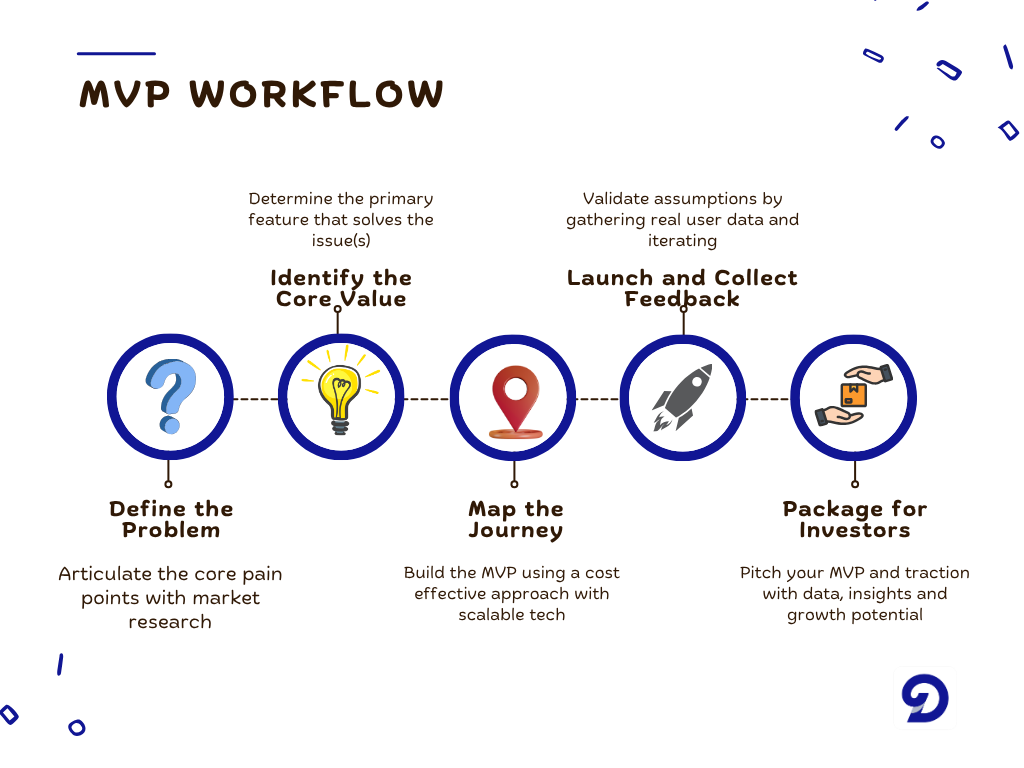
Step 1: Define the Problem with Precision
Before you write a single line of code, you need to articulate the problem you’re solving. Not in vague terms like “people want to save time,” but with specificity.
For example, instead of saying “small businesses struggle with accounting,” say:
“Freelancers earning under $100K annually spend an average of 12 hours per month manually tracking expenses, leading to missed deductions and inaccurate tax filings.”
That level of clarity shows investors you’ve done your homework. It also helps you build a product that actually addresses the pain point.
Use tools like:
- Customer interviews
- Reddit threads and niche forums
- AI language models
- Survey platforms like Typeform or Google Forms
- Industry reports (Statista, Gartner, CB Insights)
The more data you gather, the sharper your MVP will be.
Step 2: Identify Your Core Value Proposition
Your MVP should do one thing exceptionally well. Resist the urge to build a Swiss Army knife. Investors want focus.
Ask yourself:
- What’s the one feature that delivers the most value?
- What’s the “aha” moment for users?
- What’s the simplest way to deliver that moment?
Take Airbnb. Their MVP didn’t include reviews, maps, or payment processing. It was just a landing page with photos of a loft and a way to book it. That was enough to validate the idea—and eventually raise funding from Y Combinator.
Step 3: Map Out the User Journey
Once you’ve nailed the core value, sketch out how users will experience it. This doesn’t require fancy tools—pen and paper works just fine.
Think through:
- How users discover your product
- What onboarding looks like
- What action they take to get value
- What feedback loop you’ll use to learn from them
This exercise helps you prioritize features and avoid scope creep. It also gives investors a clear picture of how your product fits into users’ lives.
Step 4: Build Lean, But Build Smart
Now it’s time to build. Whether you’re coding it yourself or working with a development partner, the goal is speed without sacrificing clarity.
Use frameworks and tools that accelerate development:
- Frontend: React, Vue.js, Next.js
- Backend: Node.js, Firebase
- No-code: Bubble, Webflow, Glide (if technical resources are limited)
- Deployment: Render, GoDaddy, Vercel
Focus on usability. Investors don’t expect polish, but they do expect functionality. Your MVP should be intuitive enough that users can navigate it without a manual.
And don’t forget analytics. Tools like Mixpanel, Hotjar, or Google Analytics help you track engagement and iterate based on real data.
Step 5: Launch and Learn
Once your MVP is live, resist the temptation to sit back. This is where the real work begins.
Start small. Reach out to early adopters—friends, colleagues, niche communities. Ask for feedback. Watch how they use the product. What confuses them? What delights them? Where and what do they ignore?
Document everything. Investors love founders who are obsessed with learning. Show that you’re not just building—you’re evolving.
Step 6: Package Your MVP for Investors
Now that you’ve built and tested your MVP, it’s time to present it. Besides, Investors want to see more than a product, they want a story.
Your pitch should include:
- A clear problem statement
- A demo or walkthrough of the MVP
- User feedback and engagement metrics
- Your vision for scaling the product
- A roadmap with milestones and funding needs
Use visuals. A short video demo can be more powerful than a slide deck, hence, use tools like Loom or Pitch can help you create compelling presentations.
And be honest. If your MVP has flaws, acknowledge them and explain how you’re addressing them. Transparency builds trust.
Real-World MVPs That Attracted Funding
Some of the biggest names today started with surprisingly humble MVPs:
Buffer Started with a simple landing page explaining the product and a signup form. When people signed up, they were shown pricing plans. That validated demand before the product existed. Buffer later raised $500K in seed funding.
Zappos Before building a massive e-commerce platform, founder Nick Swinmurn took photos of shoes at local stores and posted them online. When someone bought a pair, he went to the store and bought them manually. That MVP proved people would buy shoes online.
Product Hunt was launched as an email newsletter. There was no platform or voting system—just a curated list of cool products. This simplicity helped them build a loyal audience and eventually secure funding from Y Combinator.
Common MVP Mistakes to Avoid
Even seasoned founders stumble when building MVPs. Here are a few traps to watch out for:
- Overbuilding: More features mean more confusion. Keep it lean.
- Ignoring user feedback: Feedback is your compass. Use it.
- Skipping analytics: If you don’t measure, you can’t improve.
- Pitching too early: Validate before fundraising. Proof beats passion.
Conclusion: MVPs Aren’t Shortcuts—They’re Smartcuts
A well-crafted MVP isn’t about launching fast and cheap—it’s about learning fast and smart. It’s about aligning your product with real user needs and demonstrating to investors that you’re not just building—you’re listening, adapting, and executing.
Startups get funded because they show momentum, clarity, and commitment—not because they have a beautiful slide deck. When your MVP proves users care, investors start to care too.
So build it with purpose. Build it with empathy. And build it like it’s your first investor meeting—because if done right, it might just be.
Need help building your MVP? Book a free strategy call with our team to get personalized guidance.