
In today’s business-landscape, one thing has become abundantly clear: simply talking about artificial intelligence (AI) is no longer enough. Enterprises that succeed view AI as a strategic initiative, not as a last-minute add-on. At Doshby, we’ve helped organizations move from experimentation to enterprise-wide adoption, and we know that integration is the real battleground.
Despite the hype, the actual challenge isn’t finding an AI algorithm, it’s embedding it meaningfully in business processes, systems, and culture. According to research by IBM, only about 42% of large-scale organizations (1,000+ employees) have actively deployed AI. An additional 40% are still in exploratory or pilot phases.That gap isn’t due to lack of interest — it’s due to the complexity of integration.
In this article, we’ll unpack what AI integration for enterprise really means, reveal why it matters, highlight major hurdles, offer best-practice guidance, and show how Doshby can help you accelerate from pilot to production.
What Is AI Integration for Enterprise?
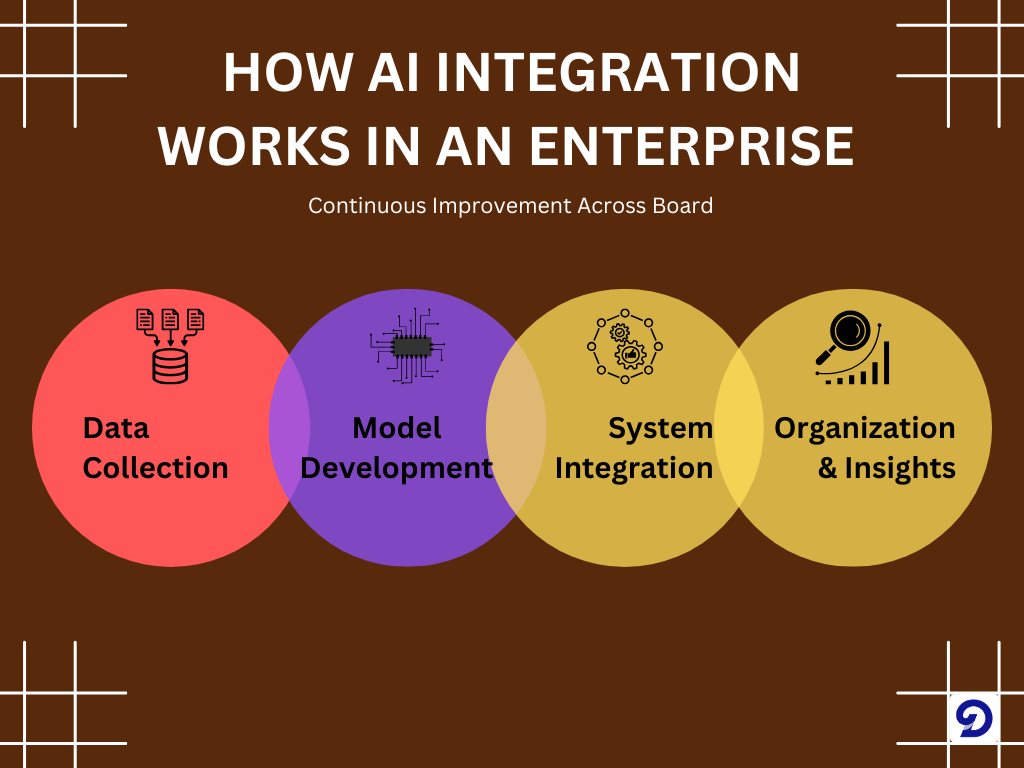
Integration, in this context, isn’t simply “plugging in a chatbot” or “adding an AI engine”. Rather, it’s about embedding AI-capable systems within an enterprise’s operational fabric. That means connecting AI algorithms to:
- existing data pipelines and repositories,
- business applications and workflows,
- decision-making processes across departments,
- and governance, security and compliance frameworks.
An AI Integration must be connected to a specific outcome, aligned with the business/company goals and objectives, while combining it with specific user goals like Customer retention, Revenue increase, Improved decision latency, Market share gain and many more.
For example, consider a global retail chain that uses an AI model to predict product demand. To add value, which is to improve decision latency, the model must connect to inventory systems, point-of-sale data, supplier portals and logistics dashboards — not live in isolation. Without that connectivity, the value quickly evaporates.
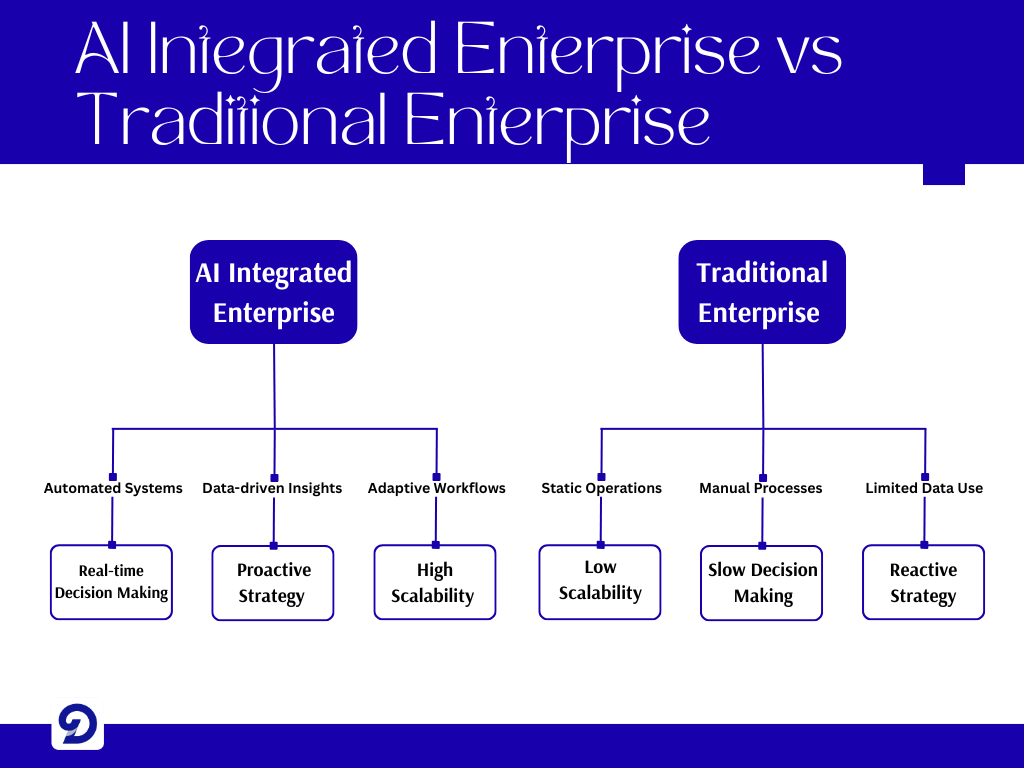
When done well, enterprise AI integration yields tangible business-outcomes: improved decision latency, enhanced automation, deeper insights, and competitive differentiation.
Why Enterprises Are Investing in AI Integration
Artificial Intelligence (AI) has rapidly become the cornerstone of digital transformation, enabling enterprises to streamline operations, improve customer engagement, and make data-driven decisions with precision. As technology continues to evolve, more organizations are recognizing AI not as a luxury, but as a strategic necessity for staying competitive in a fast-changing market. Below are some of the key reasons enterprises are investing heavily in AI integration today.
1. Efficiency and Productivity Gains
Many enterprises face relentless pressure on cost control and productivity growth. AI integration can deliver both. Research shows that enterprises using AI to automate routine tasks and extract insights are better positioned to optimise workflows and resources.
2. Enhanced Customer Experience
Customer expectations have shifted. they now expect personalised, fast, context-aware experiences. AI, when integrated with customer-facing systems, helps deliver on that promise. Whether via recommendation engines, chatbots or intelligent routing, enterprises are enhancing CX at scale.
3. Strategic Innovation and Competitive Advantage
Beyond incremental improvement, AI integration allows enterprises to re-imagine business models. A survey by Morgan Stanley projected that enterprise AI adoption could add up to $16 billion to the value of the S&P 500 through productivity gains and new revenue streams.
4. Data-Driven Decision-Making
Enterprises sit on vast troves of data, but insight generation remains a challenge. AI enables heavy-duty analytics, pattern detection and predictive capabilities. When integrated into decision processes, it turns raw data into strategic value.
In short, AI integration moves organizations from “what happened?” to “what will happen?” and that shift is powerful.
Key Areas of Enterprise AI Integration
In a nutshell, here are the key areas where enterprises can leverage AI integration:
Automation & Workflow Augmentation
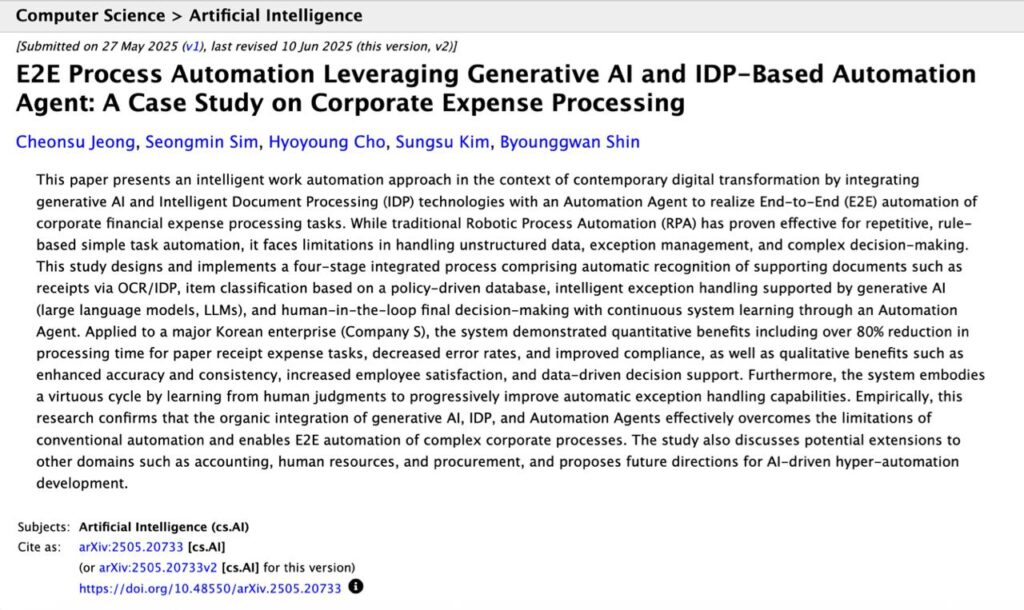
Enterprises often begin with tasks that are high-volume and repeatable: customer support via chatbots, invoice processing via Integrated Data Procession (IDP), or logistics routing. For instance, a case-study from Cornell University found that integrating generative-AI with document-processing agents reduced processing time by over 80%. The key is embedding AI into everyday workflows and enabling human-plus-machine collaboration.
Analytics & Predictive Intelligence
Connected data streams + AI models = better forecasting, anomaly detection and decision support. For example, financial services firms embed AI into fraud-detection systems that run in real time, not as after-the-fact audits.
Customer Engagement & Personalisation
From personalized offers to adaptive user interfaces, AI is increasingly integrated into CRM and marketing platforms. The business benefit is clear: more relevant engagement, higher conversion and improved retention.
Intelligent Infrastructure & Operations
AI isn’t limited to front-office functions. It’s being embedded into IT operations (AIOps), supply chain execution, and predictive maintenance. The enterprise that integrates AI into the backbone of its operations gains resilience, agility and cost-efficiency.
Governance, Compliance & Security
Integration must address more than capability — it must align with security, ethics and compliance. AI models need access to data, must operate within policies, and their outputs must be auditable. In regulated industries especially, integration is as much about control as capability. An article by Kausik Chaudhuri explains how we can prepare for the challenges of applying agentic AI to legacy systems.
FURTHER READING
➤ Agentic AI in Healthcare: A Practical Guide for Clinics
Common Challenges in Enterprise AI Integration
Just like every other technology disruption we have had over the years, there are obvious challenges that are associated with AI integration into the enterprise world, and we have put together the common ones below:
Legacy Systems & Data Silos
One of the biggest blockers to integration is the enterprise’s existing technology stack. Many legacy systems weren’t designed to interface with modern AI tools, leading to incompatible formats, data silos and integration overhead. According to research by Mohan Singh on EA Journal, 84.3% of organizations report data-silo challenges, with an average of 6.5 disparate storage systems per enterprise.

When data is inaccessible or fragmented, AI models lose context, accuracy and ultimately, value.
Skills, Culture & Change Management
Technical deployment is only part of the puzzle. Equally important is talent, mindset and change management. Skill-gaps in data science, machine learning and AI infrastructure are frequently cited as top barriers (33% of enterprises in IBM’s study identified limited AI skills as a key inhibitor).
Moreover, organisational culture often resists the disruption that AI brings. Without clear governance, training and leadership alignment, integration projects stall.
Infrastructure, Latency & Scalability
Unlike isolated prototypes, enterprise AI demands operational reliability real-time processing, high-availability, low latency and scalable infrastructure. If AI sits in a silo with limited throughput, its business impact is muted. Integration means embedding AI inside live systems that require uptime, robustness and maintainability.
ROI and Business Alignment
Many enterprises invest in AI but struggle to tie it to measurable business-outcomes. One troubling study found that 95% of generative AI implementations had no measurable impact on profit & loss.
The lesson: integration must be tied to business value, not just technology for technology’s sake.
Tom’s Hardware
Best Practices to Ensure Success
1. Start with Business Outcome
Define a clear business problem or metric you aim to improve (e.g., reduce invoice-processing time by 30% or improve customer retention by 10%). Then design AI integration around that metric, rather than the other way round.
2. Build a Modular Architecture
A modular architecture makes integration more manageable. Instead of forcing AI into a monolithic system, design microservices, APIs and event-driven workflows that allow AI modules to plug in and evolve independently.
3. Ensure Clean Data Infrastructure
Before you can integrate AI, you must integrate your data. Create a unified data strategy — break silos, standardise formats, establish pipelines. The better the data, the higher the AI returns.
4. Align Governance, Security & Ethics
Integration introduces new risks. Ensure your AI agents operate under clear policies: data access controls, audit trails, human-in-loop mechanisms and model validation procedures. In regulated sectors such as finance or healthcare, this is non-negotiable.
5. Build for Scale from Day-One
Pilot projects are useful, but true value comes from production deployment. Architect your solution so that once it works, you can scale it. That means infrastructure, APIs, pipelines and monitoring all designed to operate at enterprise scale.
6. Partner with the Right Vendor
Especially when internal skills are limited, working with a specialist partner helps accelerate integration. At Doshby, we help enterprises design the roadmap, prepare the data foundation and deploy integrated AI solutions that align with their strategic vision.
Enterprise Case Study: How Doshby Helped a Retailer Integrate AI at Scale
Consider a mid-sized retail chain seeking to optimize its logistics and inventory operations. Initially, they used disparate systems for sales, warehousing and distribution. After engaging Doshby, the following happened:
- A consolidation of data sources created a unified analytics layer.
- An AI model was integrated into demand forecasting, linked to inventory and logistics platforms.
- The result: a 25% reduction in stock-outs, a 15% reduction in logistics cost, and a 20% faster time-to-market for new product launches.
This illustrates how true integration not just adding another AI tool, can drive measurable business-impact.
The Future of AI
As we look ahead, three trends are shaping the next wave of enterprise AI integration:
- Agentic AI & Autonomous Systems: Enterprises are moving from narrow-task AI to systems that operate autonomously across workflows. However, integration complexity increases accordingly.
- AI-enabled Infrastructure (AIOps): Monitoring, self-healing and automated operations will become standard for large enterprises, and integration with AI will power higher reliability.
- Ethical, Transparent & Governed AI: With rising regulation and scrutiny, enterprises will need integrated systems that not only perform but also explain AI-driven decisions in real time.
In this evolving landscape, the companies that succeed will be those that treat AI not as a component, but as part of their operational fabric.
Make AI Integration Your Competitive Advantage
AI integration isn’t just about choosing the right algorithm, it’s about weaving intelligence into your enterprise’s DNA. When done right, it transforms workflows, systems and business models. At Doshby, we specialise in helping enterprises bridge the gap between potential and performance. If you’re ready to move beyond experimentation and build AI that matters, schedule a call with us to explore how we can partner in your AI-integration journey.