

Why Agile Has Become the Standard
In today’s fast-moving business landscape, waiting six months or more for software to launch is no longer acceptable. Requirements evolve, markets pivot, and user expectations change every week. That’s why the agile development process has surged from tech niche to mainstream strategy: it offers a way to build software that stays aligned with business needs and customer realities. At Doshby, we’ve helped clients shift from rigid “spec-then-deliver” models to agile workflows that produce value continuously, reduce risk and adapt as we learn. The agile approach isn’t simply a fad—it’s a methodology built to manage uncertainty, deliver working software early and steer development through change rather than against it. As noted by the USDS TechFAR Hub the typical agile process uses iterative cycles called sprints to convert product vision into increments of usable software.
What Is the Agile Development Process?
The Agile development process is a flexible, iterative approach to software development that focuses on delivering value quickly, responding to change, and continuously improving value through collaboration and feedback.
Unlike traditional waterfall methodologies—where planning, specification, development, testing and deployment are sequential, agile breaks work into small, manageable time-boxed iterations (often 1-4 weeks). Teams deliver increments of value, gather feedback, adapt requirements and continue. This iterative, incremental approach means software evolves rather than being built in one pass.
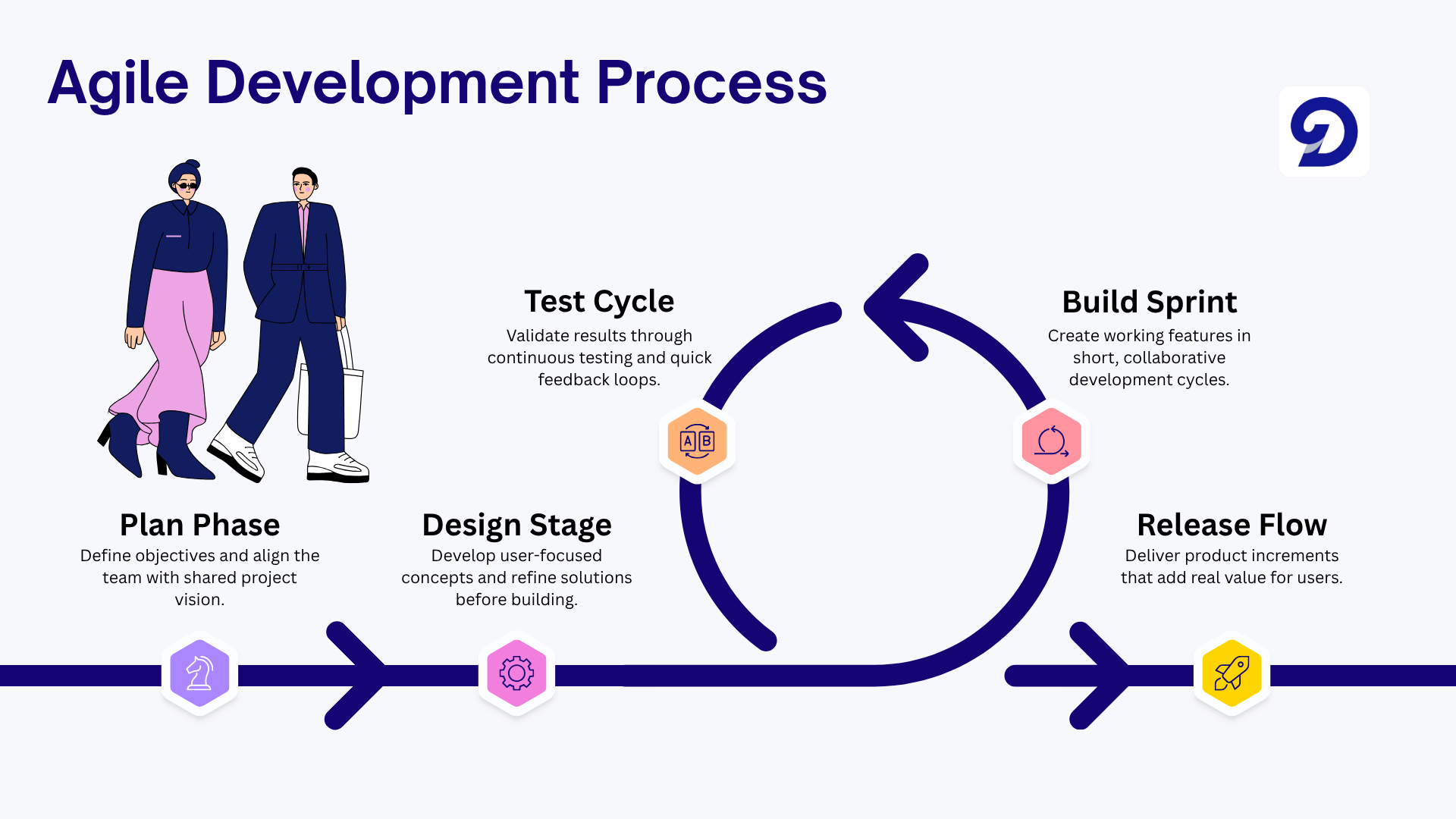
In practice, the agile development process involves a continuous flow from vision to roadmap to backlog to sprint to working software to feedback. It supports cross-functional teams, transparent communication, frequent demos and retrospectives to reflect and improve. This approach makes it possible to launch usable features quickly, adjust direction based on real user feedback, and reduce the risk of building something nobody needs.
The Pillars of Agile: Values and Principles
At its core, the agile development process is a set of methodologies rooted in the core values defined by the Agile Manifesto:
- Individuals and interactions over processes and tools
- Working software over comprehensive documentation
- Customer collaboration over contract negotiation
- Responding to change over following a plan.
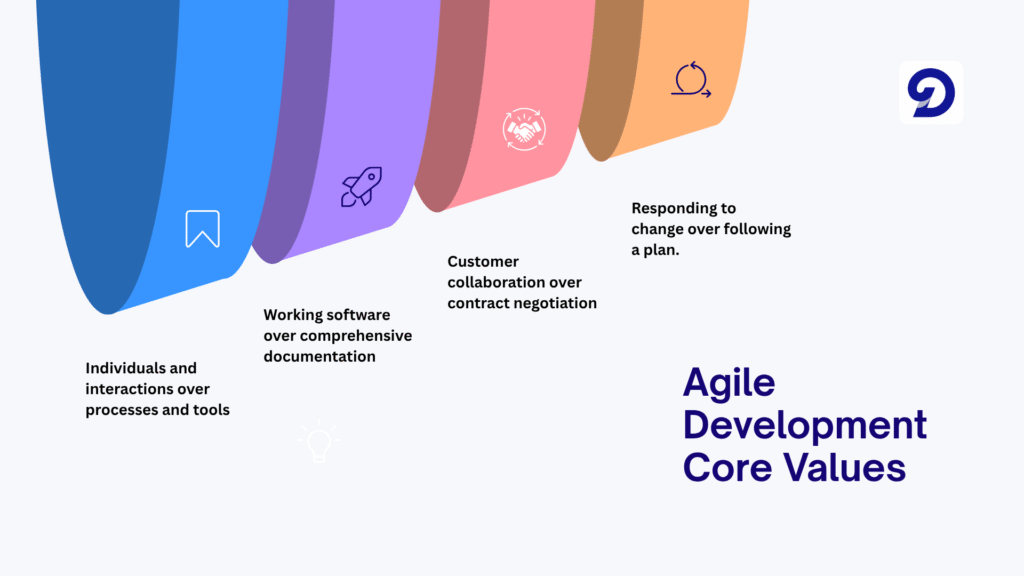
The foundation of agile is less about specific tools or frameworks and more about mindset. The four core values of agile process serve as touchstones, and beneath them lie 12 governing principles—embracing customer satisfaction through early delivery, welcoming changing requirements, delivering working software frequently, collaboration among business and development teams, supporting motivated individuals, face-to-face communication (or its equivalent), working solutions as the primary measure of progress, sustainable development pace, continuous attention to technical excellence, simplicity, self-organising teams and regular reflection on how to become more effective.
This means that adopting agile isn’t just installing Scrum boards and daily stand-ups; it’s adopting a culture of openness, experimentation and continuous improvement. At Doshby we emphasise that success comes when teams think in terms of learning loops rather than linear project ladders. Agile expects and leverages change rather than locking it out.
FURTHER READING
➤ Software Budgeting in 2025 – How to Plan and Estimate your Software Development Costs
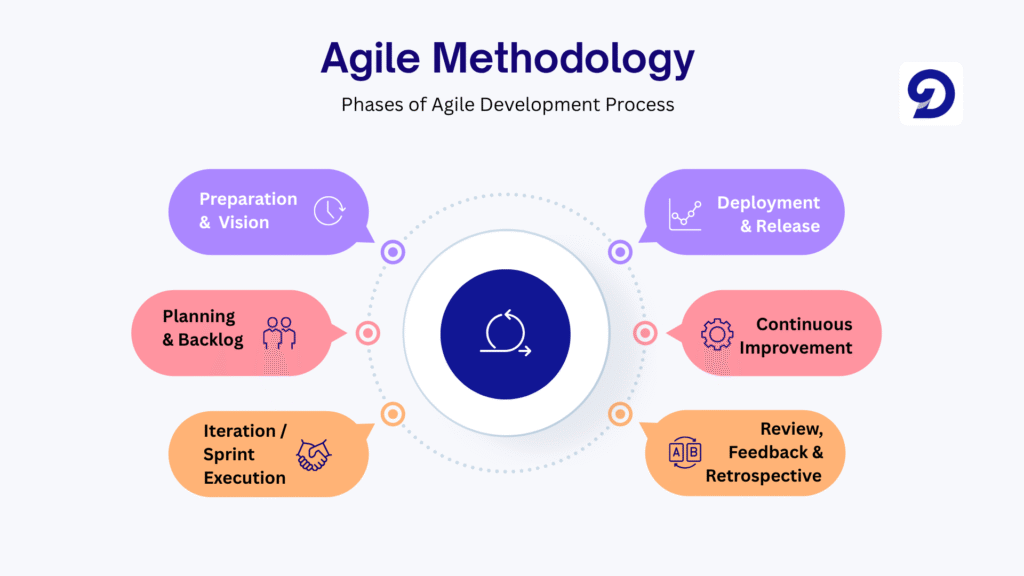
Phases of the Agile Development Process
Let’s walk through the overarching phases you should expect when implementing an agile development process, from strategy down to iteration and deployment.
Preparation & Vision
Every agile initiative begins with a clear product vision—your “why” behind the work. This may come from market research, a new business opportunity or a competitive threat. The agile process takes this vision and translates it into a roadmap, categorized by prioritized goals, rough timelines and high-level features. According to Monday.com’s recent guide, agile teams then break those goals into a product backlog: a prioritized list of user stories or features each mapped to business value.
Planning & Backlog
Once your roadmap is in place, you build a product backlog, this s known as a living list of user stories or features awaiting delivery. This list is refined continuously (often in grooming sessions) and prioritized. Stories are sized, dependencies examined and release plans drawn. In the sprint planning meeting, teams select which backlog items they will commit to for the upcoming iteration. This ensures that each sprint is purposeful and scoped to deliver real value.
Iteration / Sprint Execution
The sprint is heart of agile. Typically 1-4 weeks long (2-week sprints are common) the team commits to working on selected stories, develops them, tests them and delivers an increment of working software. Daily stand-ups help the team stay aligned, surface impediments, and quickly adjust. In essence, the team lives the agile values: cross-functional collaboration, frequent delivery and responsiveness to change.
Review, Feedback & Retrospective
At the end of each sprint, a sprint review showcases what was built to stakeholders, collects feedback and realigns the backlog. Following that, the retrospective helps the team reflect on their process: what went well, what didn’t and what can be improved. This reflection loop is key to agile’s power—it transforms each iteration into a learning cycle.
Release & Deployment
Agile encourages frequent releases, ideally multiple times per sprint or at least one major release every few sprints. Continuous integration and continuous delivery (CI/CD) pipelines help deliver to production quickly and safely. User feedback from production influences the next sprint. The agile process thereby transforms the deploy-once thinking into deploy-often, enabling real user-driven improvements.
Continuous Improvement
Even after release, the agile journey continues. Teams gather metrics (velocity, lead time, churn rate), refine processes, invest in technical excellence and adapt the backlog based on real-world usage. At Doshby, we coach teams to treat each release as the start of the next cycle—not the end of the project.
Key Roles & Team Structure
In agile development, team roles are lean and empowerment-focused. While specific frameworks differ (Scrum, Kanban, Scrumban), several roles are standard:
A Product Owner represents business stakeholders and makes decisions about prioritization and value.
A Scrum Master (or Agile Coach) ensures the team follows agile practices and removes obstacles.
The Development Team is cross-functional (developers, testers, UX designers, etc) and self-organising.
Rather than rigid hierarchies, agile teams favor collaboration, a shared sense of ownership and frequent communication. The focus is on delivering minimal viable features quickly, gathering user feedback and iterating rather than waiting for full-scale launches. At Doshby we often advise that the structure is less important than the mindset: teams must feel empowered and accountable.
Common Agile Frameworks & Practices
Among agile frameworks, Scrum is by far the most widely used—it provides a structured set of ceremonies (sprint planning, daily stand-up, review, retrospective), artifacts (product backlog, sprint backlog, increment) and roles (Scrum Master, Product Owner, Team).
Kanban is another approach—visual board-based, flow-oriented and ideal for continuous delivery rather than fixed sprints. Extreme Programming (XP) emphasises technical practices (pair programming, TDD) and is used when high code quality and rapid change matter deeply.
The key takeaway: agile isn’t one size fits all. Choose a framework that fits your culture, team size and product complexity.
Benefits of Adopting Agile
Adopting the agile development process brings multiple benefits to organizations of all sizes. Among the most significant are faster time-to-market, enabled through short sprints that deliver working software early rather than waiting months; greater flexibility, which allows teams to respond to change rather than fight it; and higher stakeholder and customer satisfaction, because users see value early, provide feedback and feel engaged.
Additionally, agile fosters better collaboration across cross-functional teams, higher visibility for leadership into progress and impediments, and reduced risk—since smaller increments mean problems are discovered sooner rather than at the end. At Doshby we’ve seen clients reduce release cycles by up to 70% and significantly improve feedback loops by embracing agile thinking.
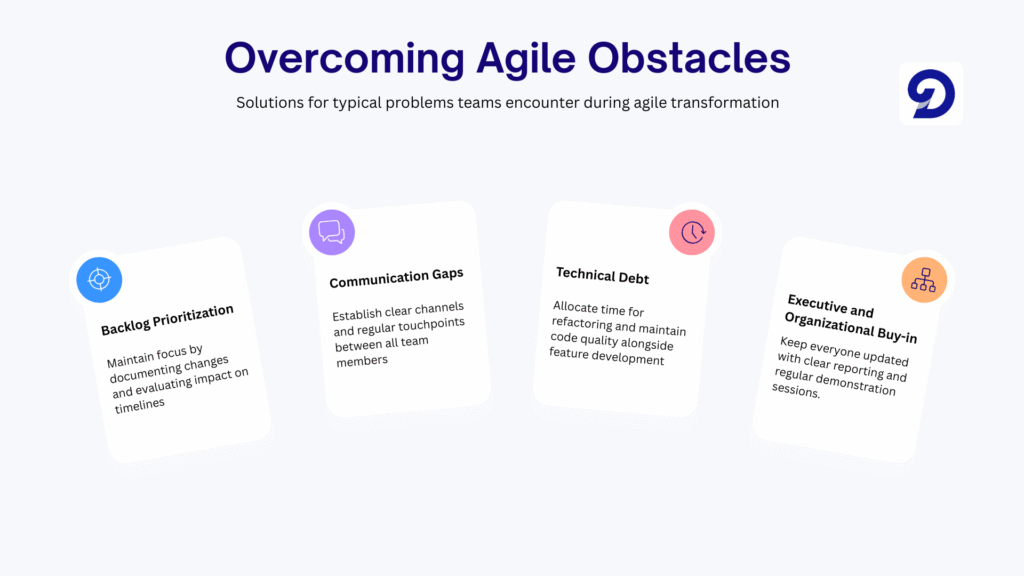
Common Challenges & How to Overcome Them
Transitioning to agile can transform a team’s delivery rhythm, but it’s rarely smooth sailing from day one. Many organizations underestimate the cultural, technical, and structural shifts required to make agile thrive. Understanding these challenges upfront and addressing them systematically can make the difference between “doing agile” and being agile.
Misunderstanding What Agile Really Means
One of the biggest hurdles is a fundamental misunderstanding of agile itself. Many teams interpret agile as “no documentation,” “no deadlines,” or “no planning.” In reality, agile requires more discipline, communication, and transparency than traditional methods. It’s not an excuse to skip strategy; it’s a framework to ensure plans adapt intelligently.
Solution:
Start with education and mindset alignment. Every stakeholder, from executives to developers must understand agile values and principles. Encourage leadership to sponsor workshops and onboard teams with foundational agile training. Emphasize that agile still involves planning, just done iteratively, not all at once.
Lack of Executive and Organizational Buy-in
Agile isn’t just a team exercise, ujhit’s an organizational philosophy. If leadership still operates under waterfall thinking (e.g., fixed scope, rigid deadlines, heavy reporting), agile teams quickly hit a ceiling. Without management support, continuous delivery and experimentation become nearly impossible.
Solution:
Executives must shift from “command and control” to “trust and empower.” Establish agile governance—a system of accountability that values outcomes over outputs. Leadership should focus on setting strategic direction, enabling cross-functional teams, and removing barriers. Frequent executive reviews of sprint outcomes (rather than reports) help maintain alignment and visibility.
Poor Backlog Management and Prioritization
A disorganized product backlog often leads to confusion, wasted effort, and scope creep. Teams may work on low-value features simply because they’re easiest to deliver. The result: software that doesn’t serve the customer or business goals.
Solution:
Appoint a strong Product Owner who manages the backlog as a living, strategic asset—not a task list. Use techniques like MoSCoW prioritization (Must-have, Should-have, Could-have, Won’t-have) or Weighted Shortest Job First (WSJF) to evaluate features by business impact. Keep backlog refinement sessions consistent, ensuring every story has a clear purpose, acceptance criteria, and estimated effort.
Ineffective Communication and Collaboration
Agile depends on constant collaboration, but remote work, siloed departments, and poor communication tools can break this rhythm. When designers, developers, and product owners operate in isolation, feedback loops slow down and sprint goals lose clarity.
Solution:
Encourage transparency through tooling and rituals. Use digital Scrum boards (Jira, Linear, ClickUp, or Notion) to make progress visible. Conduct daily stand-ups, cross-functional demos, and retrospectives religiously. Create shared documentation spaces (like Confluence or Notion) where everyone can access decisions, roadmaps, and updates in real time. Agile thrives where information flows freely.
Technical Debt and Lack of Automation
As teams race to meet sprint goals, technical debt accumulates—untested code, skipped documentation, or manual deployments. Over time, this slows development and makes agility unsustainable.
Solution:
Invest early in DevOps automation—continuous integration, continuous delivery (CI/CD), automated testing, and code reviews. Allocate time in each sprint to refactor code, pay off debt, and maintain technical hygiene. Agile teams that ignore technical excellence will eventually become slower than waterfall ones.
Scaling Agile for Growth & Enterprise
Many startups adopt agile easily; scaling agile in large enterprises presents additional complexity. Scaling frameworks (like SAFe, LeSS) share agile values but add governance, coordination across teams and product lines, and alignment with business strategy. When scaling, more emphasis goes on Value Streams, portfolio-level backlogs, systemic dependencies and agile governance.
Another consideration is tool-chain maturity: CI/CD pipelines, infrastructure as code, automated testing, monitoring and real-time analytics become essential. At Doshby, when working with enterprises we emphasize building agile architecture (not just agile teams)—ensuring that the organization’s technology and process foundations support frequent releases, independent deployment, and cross-team coordination.
Best Practices for Effective Agile Implementation
To realise the potential of agile, focus on these best practices:
- Define clear product vision and measurable outcomes before jumping into sprints.
- Build a strong product backlog: well-groomed user stories that reflect user value and business priority.
- Time-box sprints and enforce cadence: a consistent rhythm helps teams learn and improve.
- Collaborate continuously with stakeholders and users, not just at the start or end.
- Invest in test automation, CI/CD and infrastructure—this ensures delivery speed isn’t limited by deployment bottlenecks.
- Regularly reflect and adapt through retrospectives and metrics (velocity, release frequency, defects, etc).
- Tailor your framework to your culture—whether Scrum, Kanban or a hybrid, the methodology must fit your team and organization.
When to Use Agile and When to Consider Alternatives
Agile is ideal when you’re building non-commodity software, when requirements are dynamic, when user feedback is essential and speed matters. If you’re simply configuring off-the-shelf services with minimal development, agile may be overkill. Keep in mind that “If the technical needs can be met with commercially available off-the-shelf items … there may be no need to apply agile processes.”
In short: use agile when you are developing a product that will evolve, adapt and differentiate your business.
The agile development process isn’t simply a methodology to adopt—it’s a mindset to embed. When teams deliver working software early, iterate based on real feedback, adapt to change, and improve continuously, they become not just developers but strategic partners to the business. At Doshby, we help organizations design and implement agile workflows, aligning teams, architecture and process so they can respond to market shifts, deliver value rapidly, and keep evolving.
If your next project demands speed, adaptability and customer-centricity, now is the time to lean into agile. Book a conversation with Doshby’s development team and let’s build your agile advantage together.