
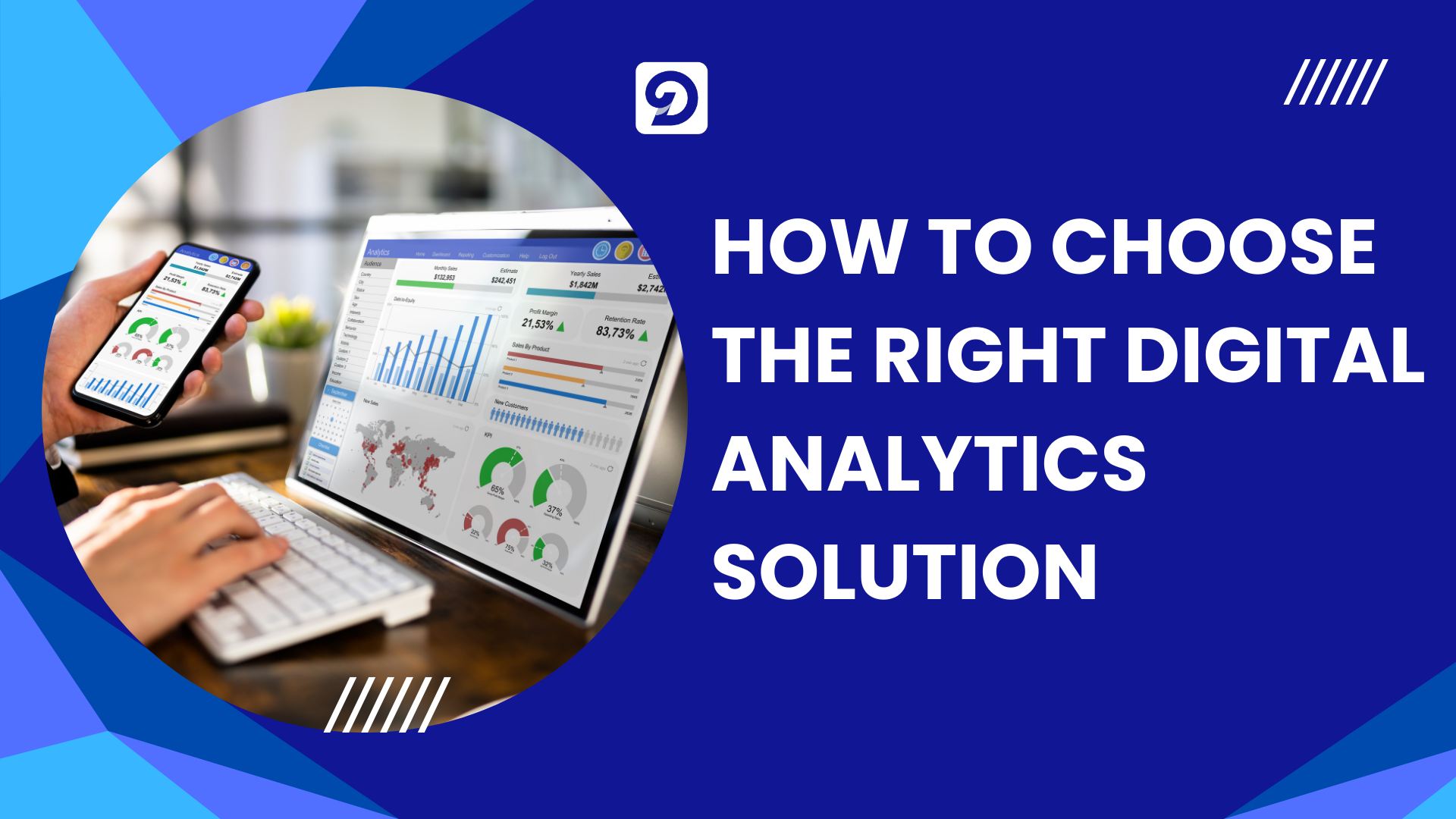
In today’s digital-first economy, data is no longer a byproduct of doing business, it is the business. Every click, scroll, purchase, and interaction tells a story about your customers, your operations, and your growth opportunities. Yet, despite the explosion of data, many organizations still struggle to extract meaningful insights that drive real decisions. The root cause is often not a lack of data, but the absence of the right digital analytics solution.
Choosing a digital analytics platform is not just a technical decision; it is a strategic investment that shapes how your organization understands users, measures performance, and plans for the future. With hundreds of tools promising dashboards, real-time insights, and AI-powered predictions, decision-makers are often left overwhelmed and uncertain.
This guide walks you through the essentials—starting from the business problem, moving through solution expectations, and ending with practical buying considerations. By the end, you will have a clear roadmap for selecting an analytics solution that aligns with your goals, scales with your business, and delivers measurable ROI.
The Real Business Problem Behind Analytics Decisions
Most organizations do not fail at analytics because they lack tools; they fail because their tools do not align with their business questions. Harvard Business Review has repeatedly highlighted that data initiatives fail when organizations collect metrics without tying them to concrete business questions. Teams often adopt analytics platforms reactively—because a competitor uses them, a vendor pitched them convincingly, or a free version seemed good enough at the time. Over time, sometimes it turns out to be a great decision, other times it results in fragmented data, inconsistent reporting, and dashboards no one fully trusts.
Executives want answers to strategic questions: Which channels drive profitable growth? Where are users dropping off? How do product changes impact revenue and retention? Meanwhile, marketing teams want attribution clarity, product teams want behavioral insights, and operations teams want performance visibility. Independent research from MIT Sloan, show that organizations that align analytics initiatives with strategic objectives are significantly more likely to outperform competitors in revenue growth and profitability. When a digital analytics solution cannot serve these varied needs cohesively, decision-making slows down and confidence erodes.
The right analytics solution should not merely report metrics, it should reduce uncertainty, enable faster decisions, and connect data directly to business outcomes.
Defining What “Right” Means for Your Organization
Before evaluating features or vendors, organizations must clearly define what success looks like. A startup tracking early user behavior has very different needs from an enterprise managing millions of sessions across multiple regions and platforms. Industry guidance from Google emphasizes that effective analytics starts with measurement planning, which involves clearly defining objectives, success metrics, and decision owners before any tool is configured
At Doshby, we encourage businesses to begin with intent-driven analytics planning. This means identifying the core decisions your teams need to make regularly and mapping those decisions to the data required. Without this clarity, even the most powerful analytics platform will feel underwhelming.
Key questions to ask internally include:
- What decisions will this data inform?
- Who will use the platform daily?
- How technical is our team?
- How often will reporting needs evolve?
The answers to these questions form the foundation of a successful analytics investment.
FURTHER READING
Core Features Every Digital Analytics Solution Should Offer
While analytics platforms vary widely in depth and specialization, certain core capabilities are non-negotiable for most modern organizations.
Comprehensive Data Collection
A strong analytics solution must capture data accurately across web, mobile apps, APIs, and third-party integrations. This includes event tracking, user sessions, conversions, and custom interactions. Flexibility in defining events and properties is essential, as rigid data models often limit future analysis.
Equally important is data reliability. Snowplow, for example, emphasizes data ownership and validation to reduce tracking errors that erode trust in analytics outputs. Inconsistent tracking or data loss can quickly undermine trust in the platform. Look for solutions that support robust tagging frameworks, server-side tracking, and data validation mechanisms.
Real-Time and Historical Reporting
Modern businesses operate in real time, and analytics should reflect that reality. Real-time dashboards help teams monitor campaigns, product launches, and system performance as they happen. At the same time, historical analysis is crucial for identifying trends, seasonality, and long-term performance patterns.
The right platform balances speed with depth, allowing users to move seamlessly from high-level dashboards to detailed drill-downs without friction.
Customizable Dashboards and Reporting
No two teams interpret data the same way. Executives prefer high-level KPIs, while analysts need granular views. A capable analytics solution allows users to create role-specific dashboards, customize metrics, and export reports in formats suitable for presentations and decision meetings.
Customization should not require heavy engineering effort. Intuitive interfaces and flexible visualization options significantly improve adoption across non-technical teams.
Advanced Segmentation and Filtering
Insights emerge when data is sliced intelligently. User segmentation—by behavior, demographics, acquisition source, or lifecycle stage—enables more targeted analysis and smarter decisions. The ability to apply filters dynamically and compare segments side by side is a hallmark of mature analytics platforms.
This capability is particularly critical for product-led growth, personalization strategies, and conversion optimization initiatives.
Data Privacy and Compliance Controls
With increasing regulatory scrutiny around data privacy, analytics solutions must support compliance with frameworks such as GDPR, CCPA, and other regional data protection laws. Features like data anonymization, consent management, and role-based access control are no longer optional.
Choosing a platform that prioritizes security and compliance protects both your customers and your brand reputation.
Evaluation Criteria That Truly Matter
Beyond features, organizations must assess analytics platforms based on how well they integrate into their existing ecosystem and workflows.
Ease of Implementation and Maintenance
An analytics solution should not become a long-term engineering burden. Complex setups, heavy customization requirements, or frequent maintenance can drain internal resources. Evaluate how quickly the platform can be implemented, how updates are managed, and whether vendor support is readily available.
Platforms that offer clear documentation, onboarding support, and implementation best practices tend to deliver value faster.
Scalability and Performance
As your business grows, data volume, user traffic, and reporting complexity will increase. The right analytics solution should scale seamlessly without performance degradation or unexpected cost spikes. This includes handling large datasets, concurrent users, and multi-region deployments.
Scalability is not just about infrastructure—it is also about maintaining usability as complexity grows.
Integration Capabilities
Analytics rarely exist in isolation. Your platform should integrate smoothly with CRMs, marketing automation tools, data warehouses, customer support systems, and BI tools. Native integrations reduce data silos and create a unified view of the customer journey.
Strong API support is also essential for custom workflows and advanced use cases.
User Adoption and Learning Curve
Even the most powerful analytics tool fails if teams do not use it. Evaluate the learning curve required for different user roles. Does the platform support self-service analytics? Are there training resources, templates, or community support?
High adoption rates are often a better indicator of success than feature depth alone.
Key Buying Considerations Before Making a Decision
Selecting a digital analytics solution is a long-term commitment, and cost should be evaluated holistically rather than purely on subscription pricing.
Total Cost of Ownership
Beyond licensing fees, consider implementation costs, ongoing maintenance, training, and potential infrastructure requirements. Some tools appear affordable initially but become expensive as data volume grows or premium features are required.
Understanding the full cost structure helps avoid surprises down the line.
Vendor Reliability and Roadmap
Your analytics vendor becomes a strategic partner. Assess their track record, financial stability, and product roadmap. Are they investing in innovation? Do they respond to customer feedback? A vendor with a clear vision and strong support culture adds long-term value.
Alignment With Business Maturity
Not every organization needs enterprise-grade analytics from day one. Overinvesting can lead to underutilization and frustration. Choose a solution that matches your current maturity level while offering room to grow.
At Doshby, we often help clients phase their analytics journey—starting with foundational tracking and gradually introducing advanced capabilities as the business evolves.
Turning Analytics Into a Competitive Advantage
Choosing the right digital analytics solution is not about finding the tool with the most features; it is about selecting a platform that empowers your teams to ask better questions and act with confidence. When analytics align with business objectives, data becomes a catalyst for growth rather than a reporting obligation.
Organizations that succeed with analytics treat it as an ongoing capability, not a one-time implementation. They continuously refine tracking, revisit metrics, and adapt dashboards as strategies change. The right solution makes this evolution possible without constant reinvention.
How Doshby Helps You Get Analytics Right
At Doshby, we work with businesses to design, implement, and optimize digital analytics solutions that are tailored to real-world decision-making. From analytics strategy and tool selection to custom dashboards and system integrations, we ensure your data works for you, not the other way around.
If you are evaluating analytics platforms or struggling to extract value from your existing setup, our team can help you clarify requirements, compare options, and implement a solution that scales with your growth.
Ready to make smarter decisions with data? Reach out to Doshby today and let’s build an analytics foundation that drives measurable results.