

Artificial intelligence in healthcare is no longer a futuristic concept, it’s a present-day reality. But as the industry evolves, a new paradigm is emerging: agentic AI. Unlike traditional AI systems that passively analyze data or automate tasks, agentic AI takes initiative. It can reason, plan, and act autonomously within defined boundaries. For clinics, this shift isn’t just technical—it’s transformational.
This post explores how agentic AI can be practically applied in clinical settings. We (you and I) will unpack what it is, how it differs from conventional AI, and what steps clinics can take to adopt it responsibly. Whether you’re running a small family practice or managing a multi-specialty clinic, understanding agentic AI could be the key to unlocking better care, smoother operations, and smarter decision-making.
What Is Agentic AI?
Agentic AI refers to artificial intelligence systems that exhibit goal-directed behavior. These systems don’t just respond to inputs—they pursue objectives. They can make decisions, adapt to changing conditions, and even initiate actions without direct human prompting.
Think of it as the difference between a calculator and a virtual assistant. A calculator waits for you to input numbers. An agentic AI assistant might notice your schedule is overloaded, suggest rescheduling appointments, and even draft messages to patients—all without being asked.
In healthcare, this means AI systems that don’t just flag anomalies in patient data but proactively recommend diagnostic tests, alert staff to potential risks, and coordinate follow-up care. It’s a leap from reactive automation to proactive intelligence.
Why Clinics Should Care
For clinics, agentic AI offers a rare combination of efficiency and empathy. It can reduce administrative burden, improve diagnostic accuracy, and enhance patient engagement—all while adapting to the unique workflows of your practice.
Imagine a system that notices a patient hasn’t booked a follow-up, checks their insurance eligibility, and sends a personalized reminder. Or an AI that monitors real-time vitals and alerts nurses before a patient’s condition deteriorates. These aren’t hypothetical scenarios—they’re already being piloted in progressive clinics.
But the real value lies in scalability. Agentic AI doesn’t just help one doctor—it helps the entire care team. It learns from interactions, refines its recommendations, and becomes a collaborative partner in care delivery.
Core Capabilities of Agentic AI in Healthcare Settings
To understand how agentic AI can be deployed, it helps to break down its core capabilities:
- Autonomous Decision-Making: Agentic systems can evaluate multiple data sources—EHRs, lab results, wearable devices—and make informed decisions. For example, recommending a change in medication dosage based on recent trends.
- Contextual Reasoning: These systems understand clinical context. They don’t just flag high blood pressure—they consider the patient’s age, history, and concurrent medications before suggesting an intervention.
- Task Delegation and Planning: Agentic AI can coordinate tasks across team, with the help of shift management software. It might assign follow-ups to nurses, schedule lab tests, and notify billing staff—all based on a single diagnosis.
- Continuous Learning: Unlike rule-based systems, agentic AI improves over time. It learns from outcomes, adapts to new protocols, and refines its behavior based on feedback.
These capabilities make agentic AI uniquely suited for the dynamic, high-stakes environment of clinical care.
FURTHER READING
➤ Microservices vs Monolith: Which Architecture Suits Your Next Software Project?
Practical Use Cases for Clinics
Let’s ground this in reality. Here are a few practical ways agentic AI is already being used—or could be used—in clinics:
1. Intelligent Triage Agentic AI can assess incoming patient data and route cases based on urgency. For example, a virtual intake assistant might analyze symptoms submitted via a patient portal and prioritize those needing immediate attention.
2. Proactive Follow-Up Management Instead of relying on staff to track follow-ups, agentic AI can monitor patient timelines, identify missed appointments, and initiate outreach. It might even adjust messaging based on patient demographics or past responsiveness.
3. Diagnostic Support By integrating with imaging systems and lab platforms, agentic AI can flag abnormalities and suggest differential diagnoses. It doesn’t replace clinicians—it augments their judgment with data-driven insights.
4. Workflow Optimization Agentic systems can analyze clinic operations and suggest improvements. For instance, identifying bottlenecks in appointment scheduling or recommending staffing adjustments based on patient volume trends.
5. Personalized Patient Engagement From sending tailored educational materials to nudging patients toward healthier behaviors, agentic AI can personalize outreach at scale. It learns what works for each patient and adapts accordingly.
These use cases aren’t just theoretical—they’re being explored in pilot programs across the U.S., Europe, and Asia. Clinics that embrace them early stand to gain a competitive edge.
Implementation Strategy: From Vision to Reality
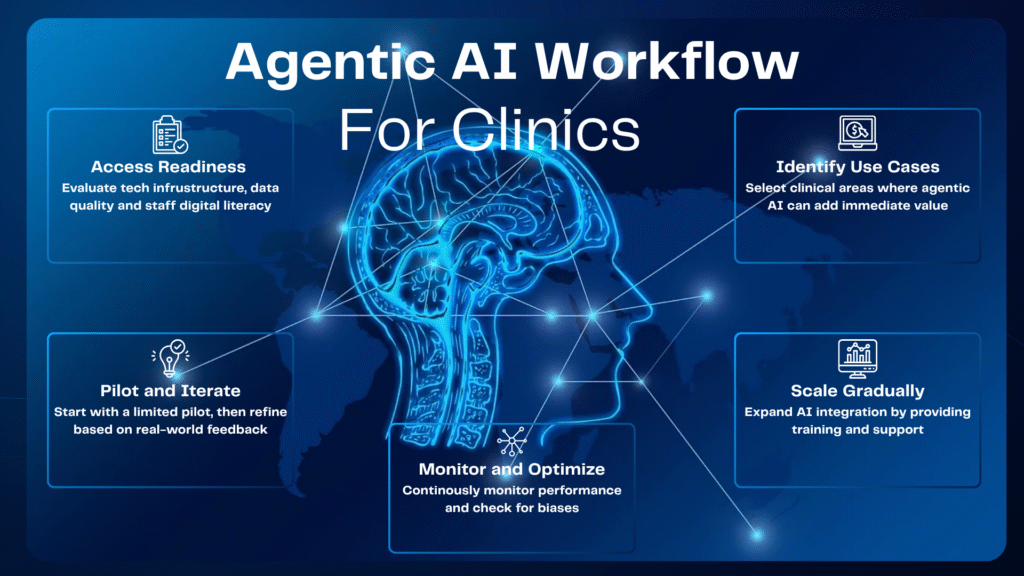
Adopting agentic AI isn’t a plug-and-play affair. It requires thoughtful planning, stakeholder alignment, and a clear understanding of clinical workflows. Here’s a practical roadmap:
Step 1: Assess Readiness Start by evaluating your clinic’s digital maturity. Do you have interoperable EHRs? Are staff comfortable with digital tools? Agentic AI thrives in environments with clean data and tech-savvy teams.
Step 2: Identify High-Impact Areas Don’t try to automate everything at once. Focus on areas where agentic AI can deliver quick wins—like triage, follow-ups, or scheduling. These are often low-risk and high-reward.
Step 3: Choose the Right Tools Not all AI is agentic. Look for platforms that offer autonomous decision-making, contextual reasoning, and adaptive learning. Ask vendors about transparency, auditability, and integration capabilities.
Step 4: Pilot and Iterate Start small. Run a pilot in one department or use case. Monitor outcomes, gather feedback, and refine the system. Involve clinicians early—they’re more likely to trust tools they helped shape.
Step 5: Scale Responsibly Once validated, expand gradually. Ensure proper training, update protocols, and maintain oversight. Agentic AI should enhance—not disrupt—clinical care.
This phased approach helps clinics avoid common pitfalls and build trust across the organization.
Ethical and Regulatory Considerations
With great power comes great responsibility. Agentic AI raises important questions around accountability, transparency, and patient consent.
Clinics must ensure that AI decisions are explainable. If a system recommends a treatment change, clinicians should understand why. Black-box algorithms may be powerful, but they’re risky in healthcare.
Patient privacy is another concern. Agentic AI often requires access to sensitive data. Clinics must comply with HIPAA, GDPR, and other regulations. Encryption, access controls, and audit trails are non-negotiable.
And then there’s bias. AI systems can inherit biases from training data. Clinics should demand fairness audits and monitor for disparities in recommendations across demographics.
The good news? Regulatory bodies are catching up. The FDA has issued guidance on AI/ML-based software as a medical device (SaMD), and frameworks like the EU AI Act are setting global standards. Clinics that stay informed and proactive can navigate these waters confidently.
The Human Element: Augmentation, Not Replacement
One of the biggest misconceptions about agentic AI is that it will replace clinicians. In reality, it’s designed to augment them.
Doctors, nurses, and staff bring empathy, intuition, and ethical judgment—qualities no algorithm can replicate. Agentic AI complements these strengths by handling routine tasks, surfacing insights, and enabling more informed decisions.
In fact, many clinicians report higher job satisfaction when supported by intelligent systems. They spend less time on paperwork and more time with patients. That’s the promise of agentic AI—not automation for its own sake, but empowerment through intelligence.
Looking Ahead: What’s Next?
Agentic AI is still evolving. Future systems may incorporate multimodal reasoning—combining text, images, and voice inputs to make decisions. Others may integrate with wearables and ambient sensors to monitor patients continuously.
We may also see agentic AI used in population health, predicting outbreaks or optimizing resource allocation across networks. The possibilities are vast—but the foundation starts in the clinic.
By embracing agentic AI today, clinics position themselves not just as adopters of technology, but as pioneers of a smarter, more responsive healthcare system.
Agentic AI represents a turning point in healthcare. It’s not just about faster diagnoses or automated scheduling—it’s about building systems that think, adapt, and collaborate. For clinics, this means better care, happier staff, and more resilient operations.
Need help understanding and implementing AI agents? Book a free strategy call with our team to get personalized guidance.